

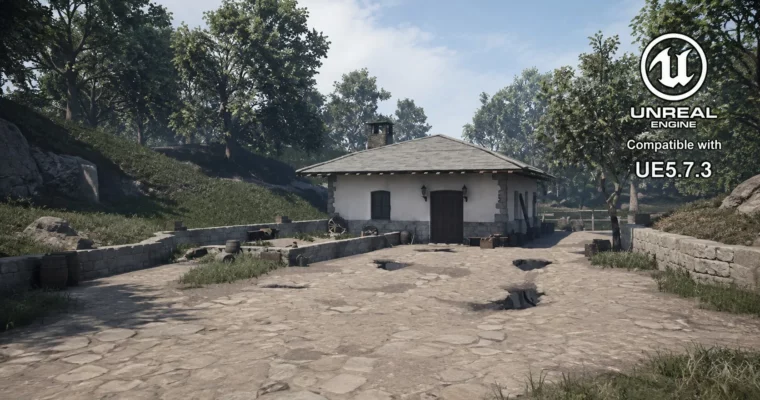
Unreal Engine 5 – Learn Environment Art for Video Games by Nicolas Bucco

Duration:40 hours on-demand video
Actual Duration:39h 54m
Release date:2026, June
Publisher:Udemy
Skill level:Beginner
Language:English
Exercise files:Yes
Software:Unreal Engine 5, 3Ds Max, Substance Painter, Photoshop
Course URL:https://www.udemy.com/course/unreal-engine-5-learn-environment-art-for-video-games/
This course is a full production pipeline for environment art, taught by someone who’s actually shipped games at Ubisoft. You’ll plan, model, texture, and assemble a complete medieval environment in Unreal Engine 5, using modular building kits and trim sheets the same way AAA studios do. No fluff, no wasted time—just a portfolio-ready piece by the end.
🎯 What you’ll learn
- Plan and organize environment projects like a professional
- Create reusable modular building kits and trim sheets
- Maintain consistent texel density across all assets
- Build basic and advanced shaders in UE5, including glass and height blending
- Sculpt custom terrain using the UE5 Landscape Tool
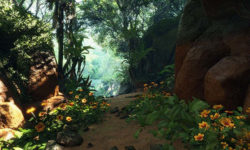
- Use the Foliage tool for organic exterior compositions
- Set up lighting, post-process, and composition for cinematic renders
- Create a professional breakdown document for your portfolio
✅ Requirements
- Skills: Basic understanding of Unreal Engine 5 is helpful but not required
- Tools: DCC package (3Ds Max, Maya, or Blender), 2D editing software (Photoshop or Canva), Substance Painter
- Hardware: Computer capable of running Unreal Engine 5
📝 Description
This isn’t another tutorial that shows you pretty renders without explaining the process. Nicolas Bucco walks you through every single step of creating a game-ready environment, from the first reference board to the final Artstation post. You’ll start by planning your modular kit on paper, then move into 3Ds Max to build the actual pieces, and finally assemble everything in Unreal Engine 5.
The course is built around a real production mindset. You’ll learn how to maintain proper texel density, organize your project structure cleanly, and integrate assets incrementally so you catch problems early. The modular approach means you’re not just building one house—you’re building a system that lets you create entire villages efficiently.
Shaders get their own deep dive. You’ll create glass materials, set up vertex painting for variation, and build a height blending shader that makes your terrain transitions look natural. Lighting and post-processing are covered in detail, so you can present your work in the best possible way.
The final section is all about career. You’ll learn how to create a professional breakdown document that clearly communicates your work to recruiters, and how to publish it effectively on Artstation. This is the stuff they don’t teach in school but absolutely matter when you’re applying for jobs.
🧑🎓 Who this course is for
- Beginner 3D artists (school students or self-taught) who want to focus on the most relevant skills
- Intermediate 3D artists who are tired of long projects that produce average portfolio results
- Junior 3D artists working in the industry who want to level up their workflow and production quality
🧑🏫 About the Author
Nicolas Bucco is a professional environment artist who has worked on shipped titles including Splinter Cell Remake, Rainbow Six Siege X, and Postal 4 No Regerts. His experience spans both AAA studios like Ubisoft and indie production, giving him a well-rounded perspective on different production pipelines. He’s condensed years of industry knowledge into this course, focusing on the techniques and workflows that actually matter in a professional setting.
🏁 Final Result
- A complete AAA-quality medieval environment built from scratch in Unreal Engine 5
- A portfolio-ready breakdown document that clearly showcases your work to potential employers
- Practical knowledge of studio workflows used in both AAA and indie productions
 Channel