


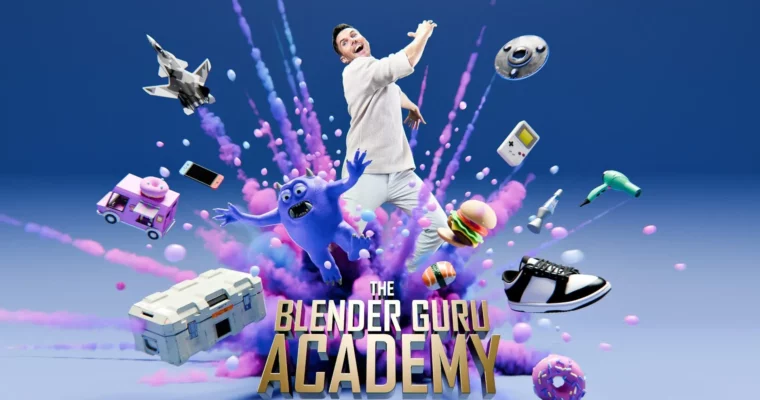
The Blender Guru Academy course for beginners by Andrew Price

Duration:2-3 months
Actual Duration:18h 2m
Release date:2026
Publisher:Blender Guru
Skill level:Beginner
Language:English
Exercise files:Yes
Software:Blender
Course URL:https://academy.blenderguru.com/join
This course is built for people who are tired of the tutorial trap. You know the drill: watch a video, follow along, but can’t make anything original. Andrew Price focuses on teaching you the principles behind the tools, not just the clicks. You’ll build three distinct projects—a sci-fi crate, a sneaker, and a monster—to learn hard surface, smooth surface, and organic modeling. Then you’ll texture, light, and render them. It’s a structured path from beginner to someone who can actually think like a 3D artist.
🎯 What you’ll learn
- Model hard surface objects like electronics and props using core Blender tools.
- Create smooth, organic shapes using SubD modeling and sculpting.
- Apply procedural and image-based textures, including UV unwrapping and custom brush painting.
- Set up lighting and cameras to tell a story and render efficiently.
- Understand the why behind each technique, not just the how.
✅ Requirements
- Skills: Basic Blender navigation (orbit, pan), moving/rotating/scaling objects, basic edit mode, adding materials and lights, rendering an image. Completion of the Blender Guru donut tutorial is recommended.
- Tools: A 3-button mouse.
- Hardware: Any computer made in the last 10 years for modeling and texturing. A CPU or GPU capable of rendering for the lighting section. Minimum 8GB RAM, 2GB VRAM GPU.
📝 Description
This isn’t another “click here, then here” tutorial. Andrew Price breaks the cycle by teaching you the fundamental principles of 3D art. You’ll learn why you use a bevel, why you add edge loops, and why a specific lighting setup works. This approach means you can apply the skills to any project, not just the one in the video.
The course is structured around three core modeling disciplines. First, you’ll tackle hard surface modeling by building a sci-fi crate from a cube. This teaches you the core tools for man-made objects. Next, you’ll move to smooth surface modeling with a sneaker, learning SubD techniques to create rounded, organic shapes without shading errors. Finally, you’ll dive into organic modeling by sculpting a monster character and then retopologizing it into a clean, animatable mesh.
The second half of the course focuses on making your models look real. You’ll learn procedural texturing to create materials like reptilian scales and leather, then move to image texturing with UV unwrapping and custom brush painting. The lighting module teaches you how to frame a shot and use light to control mood and story. You’ll even learn basic rigging and keyframe animation to pose your character. The entire course uses vanilla Blender with free extensions—no paid addons required.
🧑🎓 Who this course is for
- Beginners who have finished the donut tutorial and want a structured next step.
- Self-taught artists who feel stuck hopping between random YouTube tutorials.
- Anyone who wants to learn the principles of 3D art, not just memorize steps.
- People who want a single, substantial course (2-3 months of study) rather than a subscription.
🧑🏫 About the Author
Andrew Price is the creator of Blender Guru, the #1 YouTube channel for 3D art. With 21 years of experience, he has taught Blender to Hollywood director David F. Sandberg, and his donut tutorial was used in the Oscar-winning film Everything Everywhere All at Once. He has presented at six Blender conferences and founded Poliigon, a texture library trusted by top VFX and game studios. His teaching focuses on building foundational understanding, not just rote memorization.
🏁 Final Result
- A portfolio of three complete projects: a hard surface sci-fi crate, a smooth surface sneaker, and an organic monster character.
- Each project is fully textured, lit, and rendered.
- The ability to analyze any real-world object and plan a modeling approach.
- A certificate of completion (upon meeting grading criteria).
 Channel




Thank you so much for this course!!!!!
thank you for your good work