

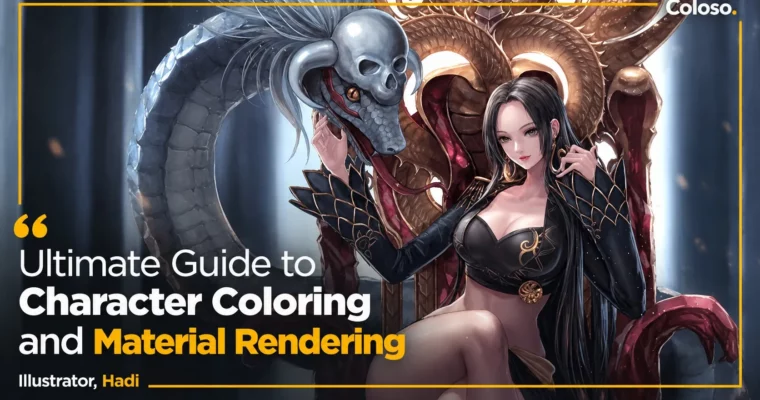
Ultimate Guide to Character Coloring and Material Rendering by Hadi

Duration:22 hours 37 minutes
Actual Duration:45h 22m
Release date:2021
Publisher:Coloso
Skill level:Intermediate
Language:English
Exercise files:Yes
Software:Photoshop
Course URL:https://coloso.co.kr/products/illustrator_hadi
Coloring decides an illustration’s finish — and material rendering decides its density. Game original artist Hadi (main original art for Terra M) teaches the full spectrum of materials a working illustrator must know: why each substance looks the way it does, what history sits behind it, and how to paint it. Across 25 lessons / 22 hours 37 minutes you train on skin, hair, fur, leather, fabric, jewels, iron and new sci-fi materials, and finish two game characters — male and female — in five upgraded designs, with 20+ material-matched Photoshop brushes included.
🎯 What you’ll learn
- Read materials through light: specular and diffuse reflection, reflectance, and how light interacts with each surface
- Paint believable skin: multi-layer behavior, SSS (subsurface scattering), ambient light, age- and tone-dependent reflectance
- Render hair and fur: sectioned hair painting, roots, baby hair, hairlines, highlights, flowing hair and animal fur
- Paint leather by type and age: suede, synthetic leather, weathered and processed leather, belts and garments
- Paint every fabric fast: cotton, linen, wool, silk, velvet, jacquard, satin — plus frills, lace and beautiful folds
- Design and render jewelry and weapons: faceted gems, accessories, armor terminology and how to wear it
- Paint iron and steel by reflectance and color: worn, dented, scratched and corroded metal, armor and patterned weapons
- Render new and natural materials: plastic, vinyl, holograms and sci-fi costume textures, flowers, vines, smoke and water
- Finish with simple effects: fire, light and lightning built directly in Photoshop
✅ Requirements
- Skills: Able to draw human figures to a reasonable level and understand light basics; coloring fundamentals helpful but the course builds them up (course level: intermediate)
- Tools: Adobe Photoshop CC (latest version recommended; around 15 of the included brushes are also Clip Studio-compatible)
- Hardware: Standard illustration PC, drawing tablet, minimum 16GB RAM recommended for layered high-resolution character files
📝 Description
Most students draw faces and bodies without trouble — then stall because their material rendering cannot carry the picture past a certain quality bar. For game original art the bar is literal: a 3D modeler must read exact material feel from your painting. Hadi’s class attacks exactly this gap, always teaching the why before the how: the properties of each substance, the reason it behaves that way, and only then the rendering method.
Training is organized by material, each closing on a real character pass. Skin starts from light physics — simultaneous reflection, transmission, absorption and scattering, SSS and ambient light — then splits into female and male faces with age- and tone-specific reflectance. Hair is built in sections (roots, baby hair, hairline, highlights) before fur and brush technique. Leather moves from type recognition to weathered low-level outfits and finished belts; fabric covers ten weaves plus costume history, garment construction and fold mechanics with force-point reading.
The second half raises complexity with level: faceted gems and accessories, iron in every worn state, full armor design (terminology, wear logic, dark armor), patterned weapons, then new materials — plastic, vinyl, holograms — composed into a sci-fi costume, and finally natural subjects and fire/light/lightning effects. Two characters rise through the levels as you learn: male (leather outfit, armor) and female (dress, armor, SF costume) — five designs total, each denser than the last.
Total: 25 lessons, 22 hours 37 minutes, with 20+ material-matched brushes provided. Level: intermediate. Card built from the manufacturer page via the Coloso dump pipeline.
🧑🎓 Who this course is for
- Painters past the beginner sketch stage who want solid coloring fundamentals that hold up in finished work
- Illustrators who can draw bodies and light but whose pictures plateau for lack of material rendering
- Artists who draw faces well yet hear their overall quality is lacking — and aspiring game original artists
🧑🏫 About the Author
Hadi is a working game concept original artist and instructor at Ego Art Academy, currently on character original art for Project M following main-original-art roles on Terra M (Krafton Scol) and Terra Origin, art-team lead at Joypin, and character art for Project L.O.M. Before games, Hadi spent years as a webtoon artist (Naver’s TATTOO, Yahoo’s ESCAPE, Nate’s WILL), with exhibitions including the Chinese Dongman exhibition and One Piece Buster Call, plus outsourcing for SK Telecom and LG Household & Health Care. The class distills that cross-field mileage into systematic drawing and coloring know-how.
🏁 Final Result
- Two finished high-density game character illustrations in five designs — male in leather and armor, female in dress, armor and sci-fi costume
- A reusable material-rendering system plus 20+ brushes: read any substance, choose the right expression, and apply it to the next character
📢 Guys, this is a Group Buy campaign, check the GBC forum thread to get access
You can find the course preview in the download section below.
 Channel