

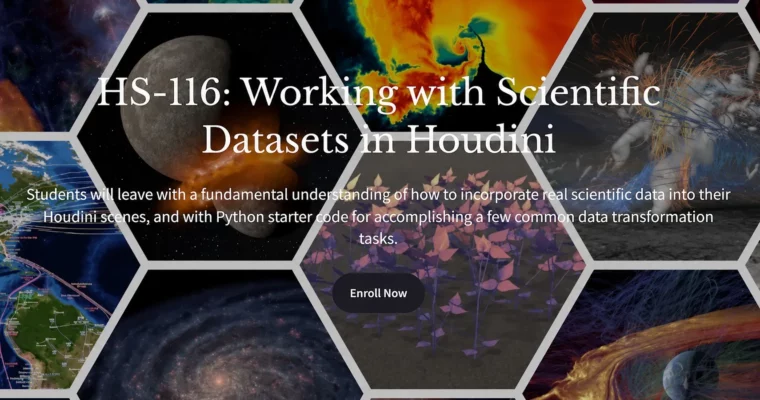
HS-116 – Working by Scientific Datasets in Houdini (2023) by Kalina Borkiewicz
Duration:2 hours
Actual Duration:2h 8m
Release date:2022
Publisher:Houdini.School
Skill level:Intermediate
Language:English
Exercise files:Yes
Software:Houdini, Python
Course URL:https://www.houdini.school/courses/hs-116-working-with-scientific-datasets-in-houdini
This course is a straight-to-the-point technical session on getting real scientific data into Houdini. You’ll work with formats like Geo/Bgeo, OpenVDB, and trickier ones like Adaptive Mesh Refinement. The focus is on the data and programming side—less on design or rendering—so you walk away with Python starter code and a solid pipeline for handling satellite, simulation, or medical scan data.
🎯 What you’ll learn
- How to wrangle and convert scientific data into Houdini-friendly formats
- Techniques for handling spatial and temporal data interpolation
- Python starter code for common data transformation tasks
- Workflows for data types like AMR, CT scans, and particle simulations
✅ Requirements
- Skills: Basic understanding of Houdini UI and 3D space; familiarity with Python scripting
- Tools: Houdini (Apprentice license is free), a code editor (e.g., Notepad++ or Sublime Text), Python 3
- Hardware: Computer meeting SideFX system requirements; a three-button mouse and second monitor recommended
📝 Description
This isn’t a fluffy overview—it’s a hands-on, code-heavy session for people who need to bridge the gap between raw scientific datasets and Houdini’s node-based world. Kalina walks through four distinct data types: satellite elevation maps of Antarctica, volumetric tornado simulations, particle data from colliding planets, and CT scans. Each module shows you exactly how to parse, transform, and load these formats into Houdini using Python and OpenVDB.
You’ll learn why some scientific formats (like Adaptive Mesh Refinement) are a pain to work with and how to convert them into something Houdini can actually chew on. The course also covers spatial and temporal interpolation—critical for animating time-varying data. By the end, you’ll have reusable Python scripts and a clear mental model for tackling any scientific dataset that comes your way.
🧑🎓 Who this course is for
- Technical artists and CG generalists who need to incorporate real-world data into their scenes
- Scientists or researchers looking to visualize their data in a professional 3D environment
- Houdini users comfortable with scripting who want to expand into scientific visualization
🧑🏫 About the Author
Kalina Borkiewicz is the former Director of Visualization at the National Center for Supercomputing Applications (NCSA) at the University of Illinois. Since 2014, she’s been part of a “Renaissance Team” blending artists, scientists, and programmers to create cinematic scientific visualizations using Houdini. Her work has appeared in planetarium fulldome shows, IMAX films, and streaming documentaries, using data from satellites and supercomputers like Blue Waters.
🏁 Final Result
- A set of Python starter scripts for importing and transforming scientific data into Houdini
- Practical experience with four real-world scientific datasets (Antarctica, tornado, planetary collision, CT scan)
- A clear workflow for handling both Houdini-friendly and unfriendly data formats
 Channel