

The Ultimate Game Art Creation Kit Maya Substance Painter by Shoaib Mohammed

Duration:20 hours
Release date:2026, October
Publisher:Udemy
Skill level:Beginner
Language:English
Exercise files:Yes
Software:Autodesk Maya, Adobe Substance 3D Painter, Marmoset Toolbag 4, Adobe Photoshop
Course URL:https://www.udemy.com/course/the-ultimate-game-art-creation-kit-maya-substance-painter/
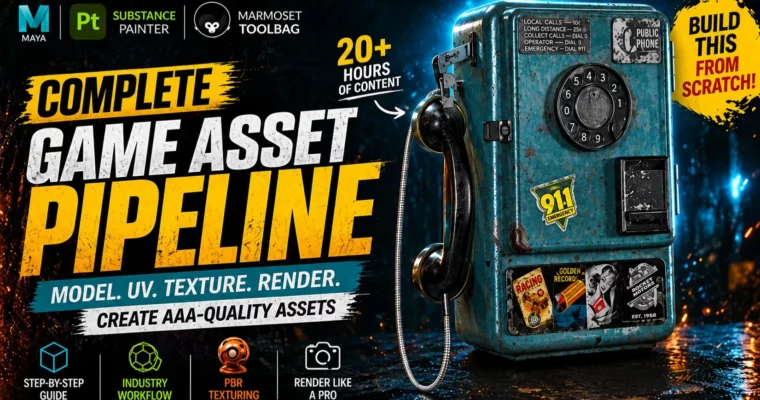
You start with a Pokeball and end with a portfolio-ready payphone. This one walks you through the full AAA pipeline — Autodesk Maya for modeling, Substance 3D Painter for texturing, and Marmoset Toolbag 4 for that final render that actually gets you hired.
🎯 What you’ll learn
- Build hard-surface game models in Maya from blockout to low-poly
- Create clean high-poly models and optimize topology for games
- Unwrap efficient UVs with good texel density for real-time assets
- Bake normal, AO, and curvature maps from high to low-poly in Substance 3D Painter
- Layer PBR materials, smart masks, stencils, and decals for realistic wear
- Light and render portfolio shots in Marmoset Toolbag 4
✅ Requirements
- Skills: No prior 3D experience needed, basic computer skills and an eye for games
- Tools: Autodesk Maya, Adobe Substance 3D Painter, Marmoset Toolbag 4, Adobe Photoshop for post-processing
- Hardware: 64-bit PC with 16GB+ RAM, dedicated GPU for baking and ray tracing, 3-button mouse
📝 Description
This isn’t theory. You build stuff from lesson one. First a simple Pokeball to learn Autodesk Maya navigation and basic forms. Then a full oil barrel — blockout, high-poly, low-poly, UVs, textures. By the time you hit the hero payphone, you already know the loop.
The payphone section is where it gets real. You’ll block out complex hard-surface shapes, push a proper high-poly with supporting edges, then retop to a clean game-ready low-poly. UVs get three full videos. No rushing. You learn how to pack shells, keep texel density consistent, and avoid the stretching and baking errors that kill junior portfolios.
Texturing is done entirely in Substance 3D Painter. You start with bakers — normal, AO, curvature — then stack up base materials, edge wear with mask generators, rust, oil spills, stencils, and decals. The instructor shows why each layer exists. Chipped paint on metal edges because that’s where hands grab it. Grime in cavities because that’s where dust sits. It’s practical, not random sliders.
You finish in Marmoset Toolbag 4. Lighting setup, camera angles, ray tracing, and output settings for sharp ArtStation shots. Plus a quick Photoshop pass for cleanup and presentation. You also cover stuff studios actually care about — mesh budgets, real-time export for Unreal Engine and Unity, and how to present breakdowns.
🧑🎓 Who this course is for
- Complete beginners who want to get into 3D game art from zero
- Maya users who can model a bit but struggle with UVs, baking, and PBR texturing
- Aspiring freelancers and studio artists who need an ArtStation-ready hero prop
- Career switchers who learn best by following full projects start to finish
🧑🏫 About the Author
Shoaib Mohammed is a 3D game artist focused on hard-surface props and real-time workflows. He teaches the full production loop — Maya modeling, Substance texturing, and portfolio rendering — with an emphasis on clean topology and job-ready presentation. His courses are built for beginners who want practical studio habits, not just button clicks.
🏁 Final Result
- A finished payphone hero prop with background elements, fully textured in Substance 3D Painter and rendered in Marmoset Toolbag 4 — ready to post on ArtStation as a complete game environment piece.
 Channel