

Desolate Tropical Islands – Cinematic Environments by Arvid

Duration:14h 43m
Actual Duration:15h 19m
Release date:2025, December
Publisher:CGlounge Studio
Skill level:Intermediate
Language:English
Exercise files:Yes
Software:Houdini, Karma, Nuke
Course URL:https://cglounge.studio/course/cinematic-island-masterclass
You start with an empty Houdini scene and end with film-ready frames composited in Nuke. This is a full production run for a real-world island build, from heightfields and biomes to Karma XPU rendering and lens treatment.
🎯 What you’ll learn
- Build production-quality terrain using Houdini heightfields and KTT
- Create realistic biome systems with SideFX Labs procedural scattering
- Shade environments with MaterialX for Karma XPU rendering
- Light, render and composite cinematic final shots in Nuke
✅ Requirements
- Skills: Basic Houdini navigation, understanding of SOPs, parameters and node workflow
- Tools: Houdini Indie or higher for Karma XPU, Nuke non-commercial or commercial, KTT plugin, SideFX Labs, Megascans via Fab
- Hardware: Dedicated NVIDIA GPU for Karma XPU, modern multi-core CPU, 16GB+ RAM
📝 Description
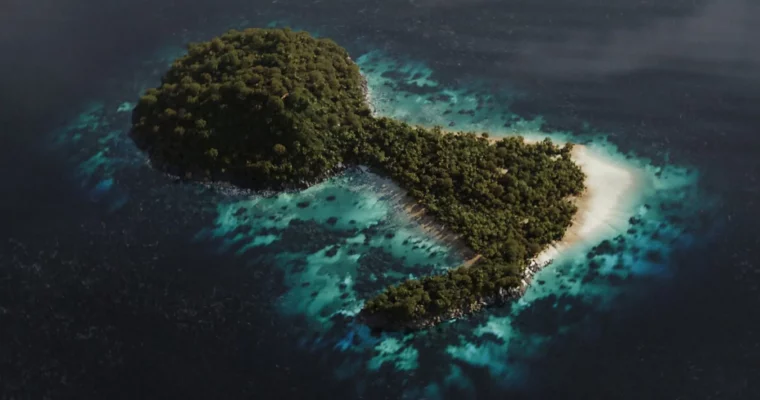
This is not a toy island. You build a 280x610m landmass based on a real location, and you do it the way shots get done. Solaris/LOPs, MaterialX, and Karma XPU all the way through, then straight into Nuke for the final look.
The workflow is built for iteration. You work resolution-independent with KTT, stack erosion without killing your machine, and bake out a mask set that drives everything downstream – shading, scattering, foam. Change the shape early, the rest follows.
Scattering is rule-based, not hand-placed. You use SideFX Labs Project Dryad to define biomes by temperature, precipitation and soil, so palms, shrubs and ground cover land where they actually would. Per-instance variation comes through USD primvars for color, roughness and glossiness, so nothing looks cloned.
Water gets two practical options. You get a fast shader ocean for lookdev and a proper Ocean Spectrum setup referenced directly in MaterialX via OP path – no 32GB displacement writes. Add animated waves, shoreline foam masks and textured seabed for depth.
Then you finish it like film. In Nuke you assemble AOVs with OpenDRT, grade with Cryptomatte to match real island photography, add 3D clouds with Cloudtastic, depth with PxF ZDefocus, plus apChroma, CG Dirt and P_Matte for lens and specular breakup. Every module ships with a HIP checkpoint and the full Nuke script includes all gizmos, so you can jump in anywhere and compare.
You need to bring your own vegetation and Megascans – Maxtree, SpeedTree or free alternatives, plus free HDRIs from Poly Haven. The course tells you exactly what to grab.
🧑🎓 Who this course is for
- Environment artists who want a real Houdini to Nuke pipeline for portfolio pieces
- Lighting TDs moving into Karma XPU, MaterialX and Solaris lookdev
- Career builders aiming for senior environment, lighting or lookdev roles
- Houdini-curious artists who already know the basics and want a full project
🧑🏫 About the Author
Arvid Schneider is an Emmy-nominated VFX Lighting Supervisor with 33 IMDB credits across ILM, MPC and Image Engine. His work includes Dune, The Mandalorian and Ready Player One. He teaches how production shots are actually built, lit and finished – no theory, just pipeline that holds up at scale.
🏁 Final Result
- A complete photoreal tropical island environment rendered in Karma XPU and finished in Nuke, with five animated cinematic camera shots ready for your reel
 Channel