

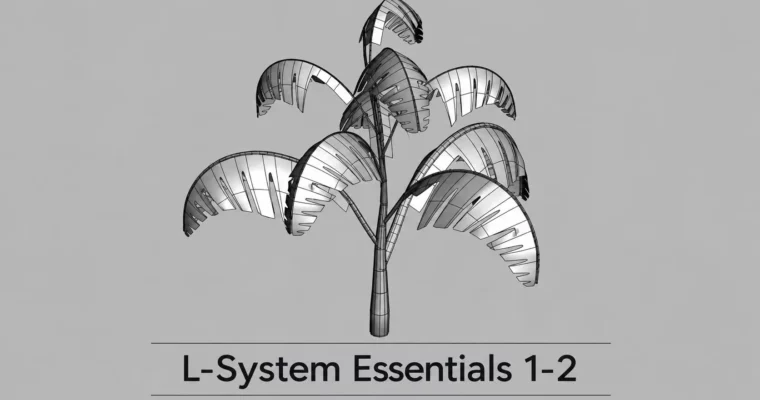
L-System Essentials 1-2 by David Gary

Actual Duration:8h 0m
Release date:2016, September
Publisher:CmiVFX
Skill level:Intermediate
Language:English
Exercise files:Yes
Software:Houdini
Course URL:https://www.compositingacademy.com/blender-nuke-vfx-workshop
If you ever wanted to actually understand L-systems instead of just copying someone else’s tree setup, this is it. You get the language, the botany logic, and a repeatable method to model any plant, tree, or branching effect in Houdini.
🎯 What you’ll learn
- How to read and write L-system rules with turtle commands
- Difference between node rewriting and edge rewriting in practice
- How to use parametric and stochastic L-systems for variation
- How to control branches with variables, expressions, and conditionals
- How to model coniferous and deciduous trees with gravity and thickness control
- How to handle leaves separately for better size and orientation
- How to plan growth with basitonic and acrotonic models and flowering phases
- How to build polygons and NURBS surfaces driven by L-systems
- How to create phyllotaxis spirals like a procedural rose
✅ Requirements
- Skills: Basic understanding of 3D space and Houdini interface, comfortable with nodes and parameters
- Tools: Houdini (Apprentice, Indie or FX), pen and paper for sketching plant formulas
- Hardware: 64-bit OS workstation capable of running Houdini, 16GB+ RAM and dedicated GPU recommended
📝 Description
This isn’t a follow-along orchid tutorial. You learn the system behind the system. The course starts with Houdini, L-systems, and branching structures — what those cryptic symbols actually do, and how turtle graphics turn text into geometry. No memorizing. You see common patterns, test them, and build intuition fast.
Then it gets into how rewriting really works. You will get the difference between node rewriting and edge rewriting, plus how parametric L-systems and stochastic variation keep plants from looking cloned. Add global variables, placeholders, expressions, and conditionals, and you can drive a whole tree from a few sliders.
Because plants are not random lines, you also get just enough botany to make it believable. That means conifers vs broadleaf logic, branch thickness, angles, gravity, and separate leaf control. For animation, you get simple, usable growth ideas like basitonic growth and acrotonic growth, plus counters and phases for flowering. And yes — pen and paper. You sketch the plant, find the formula, then build it.
The second half pushes past trees. You use recursive modeling to build toothed leaves as polygons, then use NURBS surfaces driven by L-systems for precise petal animation. The banana leaf example with COPs trimming is a great one. It ends with phyllotaxis — those efficient spirals you see in pinecones and flowers — applied to a multi-petal rose.
🧑🎓 Who this course is for
- Houdini artists who want a real method for plants, trees, and organic branching instead of one-off setups
- FX and environment artists interested in tentacles, lightning, cracks, corals, and other recursive patterns
🧑🏫 About the Author
David Gary is a French artist with a background in pure mathematics and philosophy, now working toward a PhD crossing math, phenomenology, and cognitive science. He started in CG early, directed around a dozen shorts and music videos, and has worked with 3ds Max, Maya, and Houdini. He previously taught Maya at a French studio and now focuses on procedural workflows in Houdini.
🏁 Final Result
- A set of controllable procedural plants and trees — including animated growth phases, recursive leaves, an L-system-driven NURBS petal setup, and a phyllotaxis-based rose — ready to render or extend for environments and FX shots.
 Channel