

Ad Clicks : Ad Views : Ad Clicks : Ad Views : Ad Clicks : Ad Views : Ad Clicks : Ad Views :
Oh Snap!

It looks like you're using an adblocker. Adblockers make us sad. We use ads to keep our content happy and free. If you like what we are doing please consider supporting us by whitelisting our website. You can report badly-behaved ads by clicking/tapping the nearby 'Advertisement' X text.

HS-114 – From C4D to Houdini by Matthew Taylor

HS-114 – From C4D to Houdini by Matthew Taylor

Author:Matthew Taylor

Duration:5.5 hours

Actual Duration:5h 34m

Release date:2023, June

Publisher:Houdini School

Skill level:Intermediate

Language:English

Exercise files:Yes

Software:Houdini, Cinema 4D

Course URL:https://www.houdini.school/courses/hs-114-from-c4d-to-houdini

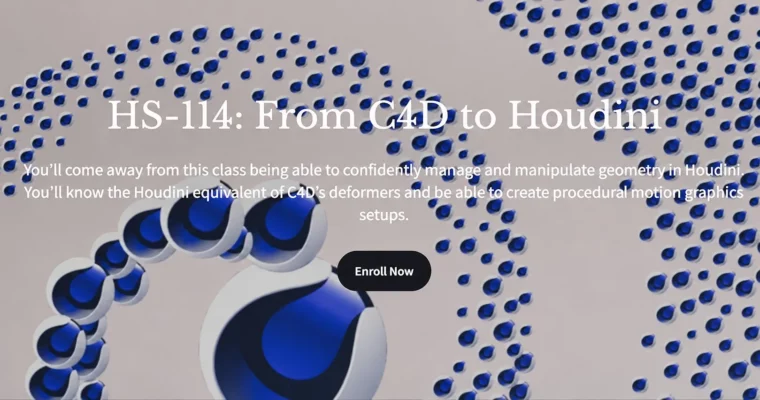
Bridge your Cinema 4D skills into Houdini by learning geometry manipulation, attributes, and procedural motion graphics setups.

This course is built for C4D artists who want to get their heads around Houdini without from scratch. You’ll learn the core concepts—attributes, VOPs, and VEX—by directly comparing them to Cinema 4D’s workflow. By the end, you’ll be building procedural motion graphics setups that would be a pain to do in C4D.

🎯 What you’ll learn

  • Confidently manage and manipulate geometry in Houdini.
  • Understand the Houdini equivalent of C4D’s deformers and Mograph effectors.
  • Create procedural motion graphics setups using attributes and noise.
  • Use VOPs and VEX to drive geometry modifications and animation.
  • Build a complete procedural tunnel animation with camera constraints.

✅ Requirements

  • Skills: Basic familiarity with Cinema 4D’s interface and core concepts like deformers and Mograph.
  • Tools: A 3-button mouse with a scroll wheel is highly recommended.
  • Hardware: A computer meeting SideFX’s system requirements for Houdini. A second monitor is recommended but not necessary.

📝 Description

This course is a straight-up bridge for C4D artists. Forget the abstract theory—Matthew Taylor walks you through Houdini’s core concepts by directly comparing them to what you already know. You’ll start by understanding the “language of Houdini,” from the node-based workflow to the crucial difference between geometry and objects.

The real meat is in attributes. You’ll learn how to read, create, and manipulate them using the Geometry Spreadsheet, then drive them with noise for procedural animation. From there, you’ll dive into VOPs and VEX, not as a programming course, but as a practical way to build falloffs and complex deformations that mimic C4D’s Mograph. The final project is a full procedural tunnel animation, where you’ll apply everything—cloning, instancing, camera constraints, and art direction—to create a portfolio-ready piece. It’s practical, hands-on, and skips the fluff.

🧑‍🎓 Who this course is for

  • Cinema 4D artists who want to learn Houdini’s procedural workflow.
  • Motion designers looking expand their toolset beyond C4D’s native tools.
  • Anyone who has tried Houdini before but found the transition from C4D confusing.

🧑‍🏫 About the Author

Matthew Taylor is a 3D Artist and Animation Director currently working at Futuredeluxe, where Houdini is his main tool. He holds an MA in Experimental Animation from the Royal College of Art and has directed animated music videos, commercials, and motion graphics for international brands. You can find his work on Instagram @humanballoons.

🏁 Final Result

  • A complete procedural tunnel animation built from scratch in Houdini, demonstrating cloning, instancing, and camera constraints.
  • A solid understanding of how to translate C4D workflows into Houdini’s procedural environment.
Curriculum

📋 Course content

  1. Module 1: Intro to Houdini
    • Welcome
    • Starting Houdini
    • Side by Side with C4D
    • Editing Objects
    • Geo vs. Objects
  2. Module 2: Geometry
    • On the Surface of Geos (SOPs)
    • Manipulating Geometry
    • Node Flags
    • Making Selections
    • Group Selections By Geometry Types
    • First Look at Attributes
    • Using the Geometry Spreadsheet
    • Polyextrude Node
    • Randomizing Attributes with Noise
  3. Module 3: Custom Attributes Driven by Noise
    • Custom Attributes Driven By Noise
  4. Module 4: Building a Falloff
    • Introduction
    • Set Group With Attribute
    • Attribute Transfer & Attribute Create
    • Polyextrude
    • Procedural Group Based on Attributes
    • Transform
    • Blend
    • Looking at VOPs & VEX
    • Blending with VOPs
    • Trick with Attribute Create
  5. Module 5: Note on Mask Using Attributes
    • Note on Mask Using Attributes
  6. Module 6: Intro to Simple VEX
    • Intro to Simple VEX
  7. Module 7: Introduction
    • Introduction
  8. Module 8: Attributes
    • Intro to Attributes
    • Randomizing Attributes
    • Intro to Vex
  9. Module 9: VOPs
    • Intro to VOPs
    • More Complex VOPs
    • Measuring Vectors with Length Node
    • Using VOP to Generate Noise
    • Using Falloff on the Noise
    • Using the Mix Node to Speed Up Noise Falloff
    • Using the Displace Along Normal
    • Building Up Visual Complexity
    • Building Up Visual Complexity 2
    • Recreating C4D Falloff Ramp with Ramp Parameter
    • Cleaning Up Network Complexity
    • Using Ramps for Colors
    • Making Custom Attributes
  10. Module 10: Little Tidbits
    • Preparing Geometry to Export for C4D
    • Importing Geometry to C4D
    • Exporting High Resolution Alembics
    • Using Primitives for Displacements
    • Curve 2.0
    • Using the Resample Node
    • Using the Sweep Node
    • Outro
  11. Module 11: Mograph in Houdini | Base Setup
    • C4D Mograph Cloner
    • Using Copy & Transform Node to Recreate C4D Cloner
    • Layering with the Copy Node
    • Copy to Points
    • Copy to Points – Surface of the Object
    • System Overload, Too Many Points
  12. Module 12: Mograph in Houdini | Pushing Things Further
    • Attribute Create – Pscale
    • Points from Volumes
    • Scatter Node
    • Copy to Points – Relax Iterations & Relax Radius
  13. Module 13: Building the Tunnel Animation
    • Starting the Tunnel Animation
    • Impacting Our Effectors
    • Wipe on Random Scale
    • Setting Up Camera
    • Using Curve Node for Variation
    • Object Merge, Into this Object
    • Using Constraints in Houdini
    • Using Carve Node to Drive the Camera
    • Setting Up Camera Contraints
    • Set Driven Set Driver in Houdini
    • Art Directing in Houdini
    • Cloning Multiple Objects
    • Instancing in Houdini
    • MOPs in Houdini
    • Submit your work
Watch online or Download for Free
HS-114 – From C4D to Houdini by Matthew Taylor
NAME
SIZEDURATION
01. Intro to Houdini
16.6 MB18m
03. Custom Attributes Driven by Noise
2.4 MB0m
05. Note on Mask Using Attributes
8.8 MB2m
06. Intro to Simple VEX
12.2 MB4m
07. Introduction
1.7 MB1m
08. Attributes
29.2 MB12m
12. Mograph in Houdini – Pushing Things Further
68.4 MB24m

Download all Videos (76)
807.4 MB5h 34m

Project Files (Assets, Resources)
159.9 KB

Download all

Join us on
  Channel    and      Group

Leave a Comment

Your email address will not be published. Required fields are marked *