

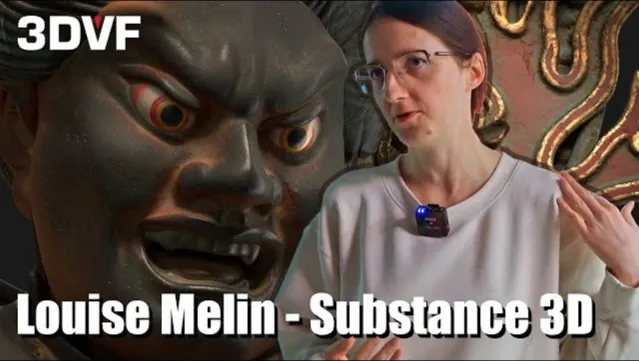
From VR Sculpting To Realistic Texturing with Adobe Substance 3D by Louise Mélin
Actual Duration:1h 1m
Release date:2020, April
Publisher:Artstation
Skill level:Intermediate
Language:English
Exercise files:Yes
Software:Adobe Substance 3D Modeler, Adobe Substance 3D Painter, Adobe Substance 3D Designer
Course URL:https://www.artstation.com/troglodette
This course walks you through a full production pipeline that very few people teach end to end: sculpting a detailed asset by hand in VR with Substance 3D Modeler, then baking and texturing it into something that holds up in a real-time render. Louise Mélin, a technical artist on Adobe’s Substance 3D team, shows how VR sculpting fits into a normal asset workflow instead of being a novelty, and how to push that high-poly detail into clean, realistic PBR materials.
🎯 What you’ll learn
- Sculpt and block out complex forms directly in VR using Substance 3D Modeler
- Prepare and retopologize a high-poly sculpt for baking without losing detail
- Bake normal, curvature, and ambient occlusion maps for a clean texture workflow
- Build realistic surface materials in Substance 3D Painter with layered masks and smart materials
- Generate grunge and wear with procedural graphs in Substance 3D Designer
- Assemble a presentable final render and portfolio breakdown of your asset
✅ Requirements
- Skills: Comfort with basic 3D concepts such as meshes, UVs, and PBR maps, plus the ability to work independently without step-by-step hand-holding
- Tools: A VR headset compatible with Substance 3D Modeler, an Adobe Substance 3D subscription (Modeler, Painter, Designer), and a pen display or tablet for texturing
- Hardware: A VR-ready workstation with a dedicated GPU, at least 16 GB of RAM, and a tracked play space large enough to move your arms freely
📝 Description
Most VR sculpting content online stops at “look, I made a cool blob in a headset.” This one doesn’t. The whole point here is to plug VR sculpting into a pipeline you can actually ship with — you sculpt high-poly detail in Modeler, then carry that work forward through retopology, baking, and texturing until you have a finished asset with real material depth.
Louise’s approach comes from her day job as a technical artist at Adobe, so a lot of the value is in the details people usually have to learn the hard way: how to judge scale inside VR when you have no physical reference, how to keep a high-poly sculpt subdivision-friendly so baking doesn’t blow up, and where a procedural graph in Substance 3D Designer saves you hours versus painting the same wear by hand in Substance 3D Painter.
The texturing section leans into realism rather than stylization. You’ll layer materials, mask them by curvature and position, and build up grime, edge damage, and dust in the order that actually reads correctly on a render. There’s also a strong emphasis on material reuse — building substances you can drop onto the next asset instead of starting from zero every time.
If you’re self-taught, you’ll probably recognize the pattern here: a lot of small technical decisions that never show up in a tutorial thumbnail but decide whether the final render looks convincing.
🧑🎓 Who this course is for
- Intermediate 3D artists who already know basic PBR texturing and want to add VR sculpting to their toolkit
- Character and prop artists looking for a workflow that produces high-poly detail faster than traditional sculpting
- Technical artists and generalists who want to understand how Modeler, Painter, and Designer connect in one pipeline
- Self-taught artists who want structure instead of piecing together scattered YouTube tutorials
🧑🏫 About the Author
Louise Mélin works as a technical artist at Adobe on the Substance 3D team, which means she spends her days close to the tools themselves — how they behave in production, where they break, and what workflows actually hold up. Her path into CG was anything but standard: she left a career as a philosophy teacher and taught herself computer graphics from the ground up, which is why she talks about self-directed learning without any of the usual hand-waving.
Alongside her tool-focused work, she has developed personal projects sitting at the crossroads of CG and history, reconstructing and visualizing historical subjects with 3D. That mix of technical rigour and research-driven subject matter shapes how she teaches: strong fundamentals, clear reasoning behind every step, and a genuine interest in why something looks the way it does.
🏁 Final Result
- A fully textured, realistic hero asset sculpted by hand in VR and ready for a real-time or rendered presentation
- A complete set of baked maps — normal, curvature, ambient occlusion — plus layered source files in Substance 3D Painter
- At least one custom procedural material built in Designer that you can reuse on future projects
- A portfolio-ready breakdown showing the pipeline from VR blockout to final render
 Channel