

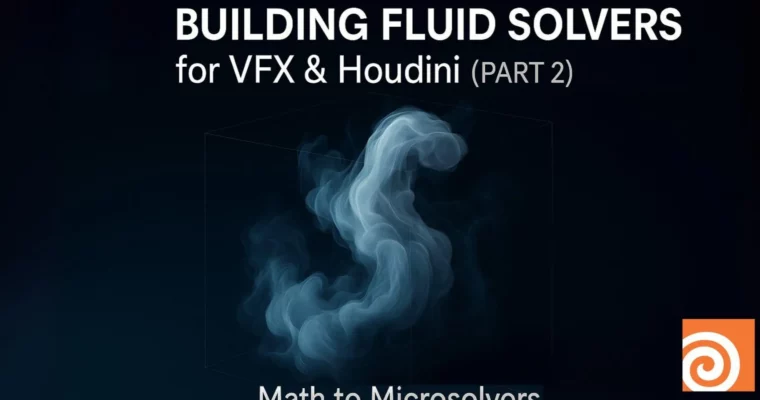
Building Fluid Solvers For Visual Effects and Houdini Part2 by Anas Alaa

Duration:7h 45m 12s
Actual Duration:7h 44m
Release date:2025, August
Publisher:CGCircuit
Skill level:Advanced
Language:English
Exercise files:Yes
Software:Houdini
Course URL:https://www.cgcircuit.com/tutorial/building-fluid-solvers-for-visual-effects-and-houdini-part2
Ready to move beyond just using fluid solvers and actually understand how they work? This course is your next step. We’re breaking down the complex math and logic behind fluid simulations into digestible pieces, giving you the foundational knowledge to start building your own custom solvers. Forget trying to replicate commercial software; this is about grasping the core concepts and techniques that power modern fluid sims, with practical examples in Houdini. You’ll get pseudocode you can use anywhere and see how a basic smoke solver comes together in Houdini’s DOP network.
🎯 What you’ll learn
- Understand the math behind simulations: ODEs, PDEs, and matrices.
- Explore the Navier-Stokes equations and their relation to real-world fluids.
- Learn MAC grids and spatial-temporal discretization for simulations.
- Master advection techniques like the Semi-Lagrangian method.
- Implement the incompressibility condition and solve linear systems.
- Build a basic smoke solver using Houdini’s DOP microsolvers.
✅ Requirements
- Skills: Completion of Part 1 or basic understanding of derivatives, vector fields, and simulation logic. Familiarity with Houdini’s DOP network and simulation context.
- Tools: No formal programming required, but best suited for those ready to connect math to actual simulation building.
- Hardware: Not specified, but a capable machine for running Houdini is recommended.
📝 Description
This course is the second part of a series focused on building fluid solvers from the ground up. We’re not aiming to create a full commercial solver – that’s a massive undertaking for a whole team over years. Instead, this course gives you the essential building blocks: the core ideas, the math, and the solver techniques that are fundamental to all modern fluid simulators. You’ll learn to translate these concepts into simple pseudocode, making them adaptable to any programming language you prefer.
We’ll then bridge theory and practice by looking at how a basic smoke solver works in Houdini, specifically using the microsolver-based DOP network. This hands-on approach helps solidify your understanding and prepares you for more advanced topics like FLIP, fire simulations, and turbulence modeling. By the end, you’ll have a clear roadmap for developing your own custom fluid solvers and a solid grasp of the underlying mathematics and logic.
🧑🎓 Who this course is for
- VFX students or professionals who want to understand solvers beyond just using them.
- Technical artists looking to write or customize simulation code.
- Houdini users curious about the inner workings of simulations.
- Anyone interested in fluid mechanics and its application in visual effects.
🧑🏫 About the Author
Anas Alaa is a freelance Visual Effects Artist and instructor with a deep passion for Houdini since 2014. He specializes in creating stunning visual simulations, with a particular focus on large-scale water simulations that have gained recognition on CGRecord. Anas has also shared his expertise as an instructor at MIX training. While water is a specialty, his skills span fire, explosions, destruction, and particle simulations in Houdini. His strong mathematical background drives his interest in the intricate math behind fluid dynamics and solvers, leading him to develop specialized courses that demystify solver construction and mathematics. Anas is dedicated to making complex concepts accessible and engaging for all learners, aiming to elevate skills and inspire creativity in the VFX field.
🏁 Final Result
- A strong understanding of the mathematics and logic behind fluid solvers.
- Practical pseudocode and workflows that can be implemented in various programming languages.
- Hands-on experience building a basic smoke solver in Houdini using microsolvers.
- A clear path and foundational knowledge for creating your own custom fluid simulation tools in the future.
 Channel