

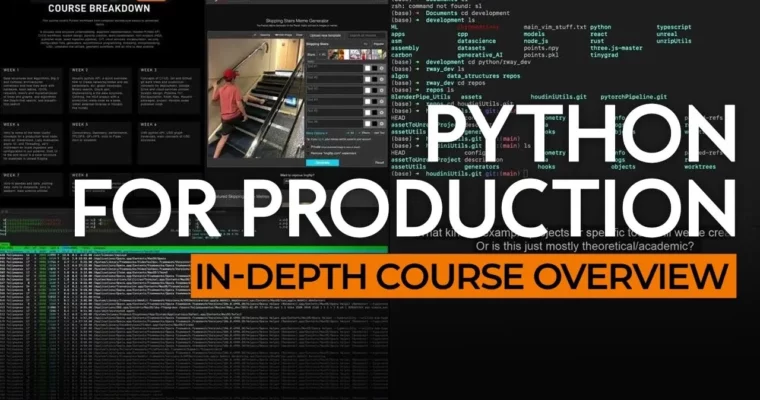
Python For Production by Felipe Pesantez

Duration:8-weeks
Actual Duration:21h 37m
Release date:2024
Publisher:Rebelway
Skill level:Advanced
Language:English
Exercise files:Yes
Software:Houdini, Python, Git, Flask, Streamlit, Unreal Engine
Course URL:https://www.rebelway.net/python-for-production
Ready to level up your VFX game? This course dives deep into writing production-ready Python code, covering everything from fundamental computer architecture and data structures to advanced pipeline tools and AI integration. If you’re looking to build robust, efficient scripts for Houdini and beyond, this is your ultimate guide.
🎯 What you’ll learn
- Understand core computer architecture and data structures.
- Implement algorithms and optimize code for performance.
- Master the Houdini Python API for node creation and parameter control.
- Develop CI/CD workflows and utilize Git for version control.
- Design and build production pipelines, including asset ingestion.
- Integrate USD and explore geometry workflows.
- Explore asynchronous programming, threading, and multiprocessing.
- Learn to use Flask and Streamlit for application development.
- Integrate AI assistants like GPT and Mistral into Houdini.
✅ Requirements
- Skills: Intermediate understanding of Houdini is recommended. Familiarity with basic programming concepts is beneficial.
- Tools: A computer capable of running Houdini.
- Hardware: Standard computer hardware sufficient for running Houdini and development tools.
📝 Description
This course is your deep dive into writing production-ready Python code specifically for the VFX industry. We’ll start by building a solid foundation in computer architecture, data structures, and algorithms, ensuring you understand how code interacts with hardware at a fundamental level. You’ll then transition into the practical application of Python within Houdini, learning to leverage its powerful API for automating tasks, creating custom tools, and building complex assets.
We’ll cover essential pipeline development concepts, including CI/CD workflows, Git for version control, and system design principles. You’ll learn how to manage configurations, integrate cloud services, and build robust systems like asset ingestion pipelines and publisher nodes. The course also explores advanced topics such as asynchronous programming, threading, and multiprocessing to optimize performance.
Furthermore, you’ll get hands-on experience with industry-standard technologies like USD (Universal Scene Description) and learn to build web applications using Flask and Streamlit. Finally, we’ll touch upon the exciting world of AI by integrating large language models like GPT and Mistral directly into your Houdini workflows. This comprehensive approach ensures you’re equipped with the skills to tackle complex challenges in a professional production environment.
🧑🎓 Who this course is for
- VFX artists looking to automate tasks and build custom tools.
- Technical artists aiming to strengthen their pipeline development skills.
- Programmers seeking to apply their Python knowledge in the VFX industry.
- Anyone interested in understanding how production code is written and managed in a studio setting.
- Students who have completed Houdini Fundamentals and Intro to Houdini FX.
🧑🏫 About the Author
Felipe Pesantez is a seasoned Technical Lead with over 12 years of experience across diverse industries including VFX, game development, CG, and technology. His extensive background includes roles as an AI Engineer, CG Generalist, and Full Stack Developer. Felipe brings a wealth of practical knowledge from working on real-world production challenges, making him uniquely qualified to teach the intricacies of writing production-ready code for demanding VFX pipelines.
🏁 Final Result
- A portfolio of robust Python scripts and tools applicable to professional VFX pipelines.
- Completed mini-projects such as custom HDAs, a publisher node, and an asset ingestion pipeline.
- A strong understanding of pipeline development, version control, and system design.
- The ability to integrate advanced concepts like USD and AI assistants into your workflow.
 Channel