

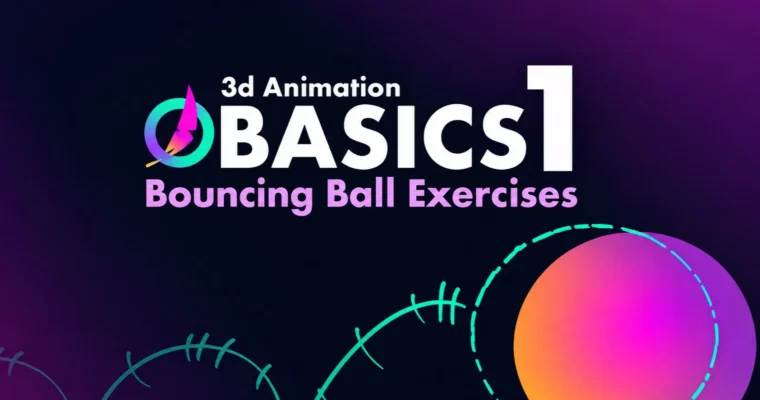
3D Animation Basics 01 – Bouncing Ball Exercises by Jorge Vigara
Actual Duration:9h 54m
Release date:2025
Publisher:Animawarriors
Skill level:Beginner
Language:English
Exercise files:Yes
Software:Autodesk Maya, Blender
Course URL:https://www.animawarriors.com/
If you can sell a bouncing ball, you can sell anything. This course takes the classic bouncing ball exercise and breaks it into five clear steps, from a simple up-down bounce to heavy and floaty materials with real timing and spacing. You will work in Autodesk Maya and finish with shots that actually feel physical.
🎯 What you’ll learn
- Animate weight and gravity with clean timing and spacing
- Control arcs and trajectory for consistent forward movement
- Use the Graph Editor with weighted curves and broken tangents
- Track motion with Motion Trails and fix floaty or sliding movement
- Add rotation and friction for bounces down stairs and over blocks
- Apply cartoon squash and stretch while maintaining volume
- Contrast heavy vs. light materials like bowling ball vs. ping pong ball
✅ Requirements
- Skills: No prior animation experience needed, basic familiarity with 3D viewport navigation
- Tools: Autodesk Maya or Blender, 3-button mouse
- Hardware: Standard workstation capable of running Maya or Blender smoothly
📝 Description
Everyone wants to jump straight to characters. Don’t. The ball is where you learn how things actually move. Hips in a walk, a head nod in dialogue, a chest landing from a jump — they all follow the same rules as a bouncing ball. Get this right and body mechanics gets ten times easier later.
We keep it simple and progressive. One axis first. Just Y, just timing and spacing. Lots of frames bunched at the top for that slow ease, few frames stretched out on the fall for speed and impact. Then we add forward travel. Pro tip that saves a lot of pain: keep that horizontal translation linear in the Graph Editor. If that curve bends, your ball speeds up mid-air for no reason.
Then it gets fun. Stairs, blocks, rotation, friction. You will learn to read Motion Trails like a second pair of eyes and spot broken arcs fast. After that we break physics on purpose with cartoon squash and stretch — stretch along the path right before hit, flat squash for one frame on contact, and always keep the volume. Last step is weight. A bowling ball and a ping pong ball do not live in the same world, and your spacing has to prove it.
🧑🎓 Who this course is for
- Complete beginners setting up their first shot in Maya or Blender
- Self-taught animators who want to fix floaty timing and sliding balls
- Students working through the Animawarriors curriculum before body mechanics
🧑🏫 About the Author
Jorge Vigara is an instructor at Animawarriors focused on fundamentals-first training. His approach is practical and shot-based: isolate one principle at a time, fix it in the Graph Editor, and build up to full performance. He teaches the core workflow behind character animation so students can move into walks, jumps, and acting with solid spacing habits.
🏁 Final Result
- A set of five polished bouncing ball shots showing timing, arcs, rotation over obstacles, cartoon squash and stretch, and heavy vs. light weight contrast — ready for a starter reel.
 Channel