

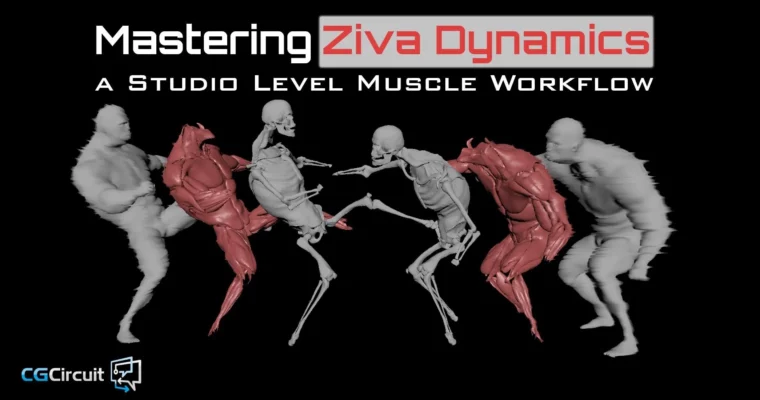
Mastering Ziva Dynamics – A Studio Level Muscle Workflow by Noah Schnapp

Duration:17h 53m
Actual Duration:17h 51m
Release date:2021
Publisher:CGCircuit
Skill level:Intermediate
Language:English
Exercise files:Yes
Software:Maya, Ziva Dynamics, Python, Wrap3D
Course URL:https://www.cgcircuit.com/products/mastering-ziva-dynamics
If you have ever watched a muscle sim crawl and thought there has to be a faster way, this is it. Noah walks you through a real studio workflow for building, migrating, and optimizing Ziva muscles so you can hit art direction notes fast and still make episodic or commercial deadlines.
🎯 What you’ll learn
- Build a complete Ziva muscle, tissue, bone and fascia setup from scratch
- Migrate an existing muscle rig to a new character and cut setup time in half
- Create clean fascia meshes and transfer them across different topologies
- Write Python build scripts, muscle attribute IO tools and a simple muscle UI
- Set up a rig breakout with muscle, tissue and fascia LODs for faster sims
- Control muscle behavior with excitation, line-of-actions and set-driven-keys
- Run and debug shot simulations, including solver settings, preroll and caching
- Composite animation and simulation caches with a fast non-wrap solution
✅ Requirements
- Skills: Intermediate Maya, basic understanding of rigging and skinning, basic Python reading skills
- Tools: Maya, Ziva Dynamics plugin, Wrap3D for reconforming, code editor for Python
- Hardware: Fast multi-core CPU for simulation, 32GB+ RAM recommended, 3-button mouse
📝 Description
Muscle sims are heavy. No machine is fast enough to brute-force them. This course is about working smart with Ziva Dynamics, so you get a stable muscle system up and running without waiting days for simulation time to finish.
You start with the basics – viewport setup, Ziva menus, attachments, collisions, materials, cloth, isomesher – then you get into the stuff that actually saves you in production. That means building clean fascia from scratch, fixing armpits, neck and crotch areas, and transferring muscles and fascia between characters with fascia wraps, harmonic warp and Wrap3D.
Then it turns into a proper pipeline course. You will write Python build scripts, parse Ziva nodes, wire up a muscle control system with line-of-actions, and build save/load tools plus a small UI so other artists can use your rig. The big win is the rig breakout system with LODs and fast cache compositing – you sim only what you need, version your caches cleanly, and blend animation and sim together at the end.
Last section is all shot work. Scaling rigs, tuning behavior, setting solver settings, dealing with preroll, debugging fascia explosions, and compositing in Maya for final output. If you do the work, you end up with a repeatable workflow from modeling to sim to render that fits episodic timelines.
🧑🎓 Who this course is for
- Intermediate Maya riggers and CFX artists who want a production-ready Ziva workflow
- Tool-minded TDs who want to automate muscle builds with Python and LOD breakouts
🧑🏫 About the Author
Noah Schnapp is a Rigging TD and tool developer with 15+ years in animation, episodic, film and games, working out of Los Angeles and Vancouver. His credits include Black Panther, Justice League, Netflix features, Super Bowl spots, and shows like 911, Snowpiercer and Orville.
His thing is efficiency – pipeline development, smart rig breakouts, and tools that let artists answer notes faster. When he is not in the studio he is 3D printing, designing, and racing drones professionally.
🏁 Final Result
- A fully rigged and simulated character with muscles, tissues, bones and fascia, plus Python build tools, LOD breakout rig, and composited shot caches ready for reel breakdown.
 Channel