

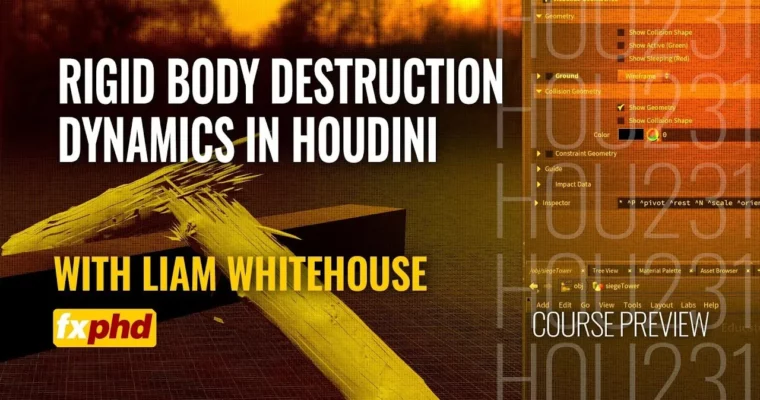
Rigid Body Destruction Dynamics in Houdini by Liam Whitehouse

Duration:6 hours 52 minutes
Actual Duration:6h 52m
Release date:2024, April
Publisher:REQUIRES UPDATE
Skill level:Intermediate
Language:English
Exercise files:Yes
Software:Houdini 18, Solaris, Karma XPU
Course URL:https://www.fxphd.com/details/670/
Stop letting your simulations look like generic rubble. This course takes you straight into the meat of rigid body dynamics in Houdini, using a medieval siege warfare scene as your testing ground. You aren’t just simulating objects falling; you’re learning how to art-direct the chaos to meet a director’s specific notes.
🎯 What you’ll learn
- Create detailed fractured assets ready for FX splitting.
- Use RBD Bullet Solvers for realistic brick and wood destruction.
- Art-direct simulation parameters like timing, scale, and impact direction.
- Generate secondary dust and splinter particles for added realism.
- Render final previews using Solaris and Karma XPU.
✅ Requirements
- Skills: Basic understanding of 3D space, familiarity with Houdini node-based workflows.
- Tools: 3-button mouse, drawing tablet (for keyframe refinement if needed).
- Hardware: Minimum 16GB RAM, dedicated GPU (for efficient Karma XPU rendering and viewport performance).
📝 Description
We’re building a medieval siege sequence to tackle the gritty reality of VFX destruction. The goal isn’t just to make things break; it’s to make them break exactly how a supervising artist wants them to. You’ll start by modeling assets specifically designed for fracturing, ensuring that visual detail isn’t lost when the physics engine takes over.
The core of the course focuses on two main materials: brick and wood. For bricks, we use RBD Bullet Solvers and DOPS to create impact points that react to catapult strikes. You’ll learn how to control the shape, scale, and direction of the debris field. For wood, we move beyond simple splitting and tackle wood grain fracturing, simulating how timber actually bends and shatters under stress.
A huge part of this pipeline is art direction. Real VFX isn’t just about correct physics; it’s about storytelling. You’ll learn techniques to adjust animation timing and use guided simulations to force the destruction in a specific direction, mimicking the feedback loop between an FX artist and a director. Finally, we wrap up by rendering the scene in Solaris using Karma XPU to create production-ready previews.
🧑🎓 Who this course is for
- VFX Artists looking to upgrade their RBD skills beyond basic setups.
- Houdini users wanting to understand the nuance of art-directed destruction.
- Aspiring FX Generalists interested in environmental destruction for film and games.
🧑🏫 About the Author
Liam Whitehouse is an Australian Senior VFX artist with over two decades of industry experience since 2003. His portfolio spans major blockbuster titles, including environments in The Fall Guy, underwater scenes in Aquaman 2, and the forests of The Rings of Power. He has also contributed to photorealistic environments in The Falcon and the Winter Soldier and Godzilla vs. Kong, bringing deep practical knowledge of VFX pipelines to this course.
🏁 Final Result
- A fully simulated and rendered medieval siege sequence featuring detailed brick wall impacts and wooden siege tower destruction, ready for portfolio review or VFX pipeline integration.
 Channel