


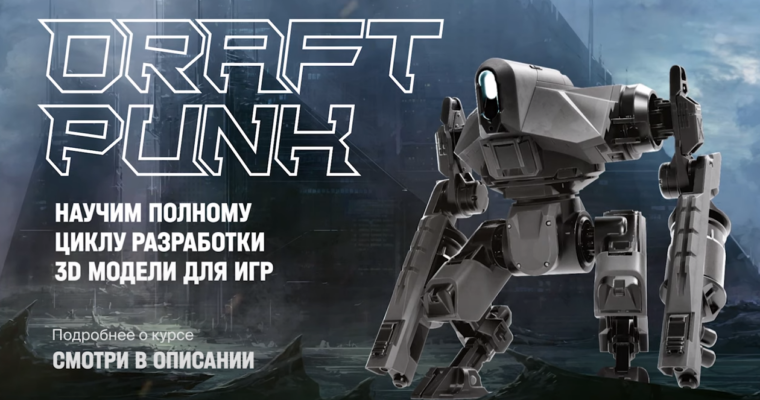
Draft Punk 4.0 – 3D Modeling for Games (Russian, Eng sub)
Duration:23:59:00
Actual Duration:23h 59m
Release date:2021, May 8
Skill level:Beginner
Language:Russian
Exercise files:Yes
Course URL:https://www.school-xyz.com/draftpunk
The course aims to help you take the first step towards the profession of a 3D modeler. In 6 months, you will learn how to create models for games and deal with the technical part of modeling: all these high-poly, low-poly, sweep and baking.
Who Is The Course For?
- For beginner 3D artists. You will understand the cycle of creating a model from the concept to the final submission. You’ll make useful acquaintances and learn how to model, so you don’t have to redo it later.
- For designers and 2D artists. You will increase your income because they pay more for 3D. Strengthen your portfolio. You will open up new opportunities for creativity and professional growth.
- For indie developers. You will learn how to quickly make simple but expressive models to be less distracted from development and not waste time on asset stores and marketplaces.
What You’ll Learn:
- Create 3D models for games according to the correct algorithm: first form and expressiveness, then sweep, baking, and textures.
- a Better understanding of how to use 3D modeling software (Maya, Blender, Substance Painter, Marmoset Toolbag) and Photoshop.
- To cause a “wow effect” among friends, HR’s and customers with the help of a beautiful presentation, place models on Sketchfab and Artstation.
Curriculum:
Block 1. Introduction to the course
The path of development of a 3D artist and employment in the field.
- How the training program works.
- How to do homework and upload them to Sketchfab.
Block 2. Pipeline — model creation algorithm
What is a pipeline … and why it’s so important to stick to it.
- Pipeline stages. Which ones, how many, and what do you need to know?
- Variations of the pipeline. Different approaches to creating 3D models.
Block 3. Draft sketch of the model
Its features and the creation process.
- What are references? How to search for them, analyze them, and use them.
- What are primitives and proportions, and how to create silhouettes.
- How to color a draft and make it expressive.
- The importance of detail and how damage makes the model more enjoyable.
Block 4. Technical stages of model creation
What is topology, and why is it important? The most common mistakes and how to avoid them.
- Why do we need a detailed high—poly model – high-poly? How to create and what to do with it next.
- Why do we need a lightweight, low—poly model – low-poly? How to create and what to do with it next.
- What is UV scanning, and how to make and optimize it?
- What is baking and how to bake properly in Marmoset Toolbag?
Block 5. Textures
We study the information about the section and consider the files needed to complete the tasks of the block.
- Let’s figure out what PBR is and how to make realistic textures and models of “metals” and “non-metals.”
- We learn how to work with Substance Painter, transfer textures to 3D models, and get acquainted with baking maps.
Block 6. Feed
We will learn how to emphasize the advantages and hide the disadvantages of the model with the help of light, shadow, and composition.
- We understand how to prepare and arrange the work to attract the attention of other modelers, HR’s, and customers.
1. Введение в курс
1. О профессии
1. Пути развития 3D-художника
1-1_Пути развития 3D художника-v2
2. Трудоустройство
2. О курсе
1-3_О чем курс-v2
1-4_Как построена программа курса-v2
3. Гайдлайн по домашкам
1-5_Гайдлайн по домашкам-v2
1-6_Загрузка модели на Sketchfab-v2
Sketchfab – заливаем и настраиваем драфт
2. Пайплайн
1Что такое пайплайн
2Основные этапы пайплайна
2-2_Основные этапы пайплайна-v2
3Важно знать
4Вариации пайплайна
5Пара слов о Mid-Poly
3. Драфт
1Пайплайн драфта
2Работа с референсами
1О референсах
3Анализ референсов
4ДЗ Референсы
3Блокинг
1Примитивы и пропорции
3-4_Примитивы и пропорции-v2(1)
3ПС Примитивы
Разбитие на примитивы_Ответы на вопросы
Разбитие на примитивы_проверка работ
4Блокинг
5ПС Блокинг
Ответы на вопросы 220221
Проверка работ 220221
6ДЗ Блокинг
7Силуэты
8ДЗ Силуэты
4Уточнение и вторичные формы
1Уточнение и вторичные формы
3-7_Уточнение и вторичные формы-v2
2Выразительность
5Покраска
5Детализация
1Детализация
3О повреждениях
4. Технические этапы
1Матчасть (топология)
1Подобъекты
2Кольца и петли
3Что такое топология
4Основные ошибки топологии
5Edge Flow
2High-Poly
1Основные требования к HP
421 Основные требования к HP(1)
2Способы создания HP
422 Способы создания HP (Sub-D, Sculpt)(1)
3Как работает Sub-D
4Создание поддержек
424 Создание поддержек (Support Loops)
4241 Практика
5Кризы
6Переходы и сшивание геометрии
426 Переходы и сшивание геометрии
4261 Практика
8Мелкая детализация и флоатеры
427 Мелкая детализация и флоатеры
9Ускорение работы в ZBrush
428 Ускоряем работу при помощи ZBrush
3Low-Poly
1Основные правила
2Степень детализации
3Способы создания LP
4Оптимизация
5Сшивание геометрии
6Шейдинг
7Lock нормалей
9Ретопология
4UV Mapping
1Что такое UV
2Пайплайны создания UV
3Способы маппинга
443 Способы маппинга и создание швов
4Unfold UV
5Выравнивание UV
6Texel
7Оптимизация UV пространства
8Паковка и паддинг
9Прямоугольные текстуры
5Baking
10Бейк в 2 прохода
11Исправление артефактов
12Паддинг
13Подробнее о Normal
14Ambient Occlusion
07 Ambient Occlusion
08 Устранение окантовки
11 Особенности бейка АО
15Дополнительные карты
16[Стрим 2] Ответы на вопросы
2Подготовка модели
3Cage и процесс запечки
4Шейдинг
5Скосы
6Нормали и работа с ними
7[Стрим 1] Ответы на вопросы
8Смещение оверлапов
9Тестовый бейк
5. Текстуры
2Теория PBR
1PBR Материалы
01_PBR_Типы_Материалов
02_PBR_Эффект_Френеля
03_PBR_Сохренение энергии
04_PBR_Albedo
05_PBR_Reflectivity
06_PBR_Microsurface
07_PBR_Pipelines
2PBR Пайплайны
08_PBR_Spec-Gloss
09_PBR_Metallic_Roug
10_PBR_Сравнение_пайплайнов
11_PBR_Как_пофиксить_белый_контур
3PBR Вспомогательные текстуры
01_Ambient_Occlusion
02_Curvature
03_World_Space_Normal
04_Position
05_Color_ID
06_Emissive
07_Thickness
4PBR Калибровка материалов
3Workflow Basics
10Filters & Passthrough Blend
10 Filters & Passthrough Blend
Filters Passthrough Blend
11Anchor Points
11_Anchor Points
Anchor Points
12Paint Tools Brush & Eraser
12 Paint Tools Brush & Eraser
Paint Tools Brush Eraser
13Paint Features
14Presets
15Filter Gradient
16Generator UV Border Distance
15 Generator UV Border Distance
17Quick Mask
18Export Textures
19Export Configuration
1Baking maps
20Opacity
21PBR Калибровка материалов
2Fill Layers Pipeline
02 Fill Layers Pipeline
Fill Layers Pipeline
3Generators
4Paint Effect
5Polygon Fill
6Base Masks
7Smart Masks
8Smart Materials
08 Smart Materials
Smart Materials
9Normal & Height
6. Подача
1(Кнопки) Marmoset Toolbag
1Интерфейс и навигация
2Объекты сцены
3Среда и освещение
4Камера
5Дополнительные объекты сцены
6Материалы
7Параметры рендера
7Настройки рендера
Sketchfab – marmoseet toolbag 4
2Рендер и подача
1Импорт и настройка модели
2Ракурс камеры
3Настройка освещения
4Marmoset Viewer
Общие стримы
01. DP4 – 40 min Draft, стрим со студентами. 07.08.20
02. DP4. Вводный стрим
03. Экспозиция пайплайна и драфта
04. Анализ референсов разбитие на примитивы
05. Блокинг
06. Силуэты
07. Уточнение и вторичные формы
08. Покраска драфта цветом
09. Третичные формы
10. Sketchfab заливаем и настраиваем драфт-01
10. Sketchfab заливаем и настраиваем драфт-02
11. Переломный стрим
12. High-poly
13. Использование ZBrush для создания HP
14. Low-Poly
15. Разбор кейсов HP
16. Первый стрим 21 года
17. UV Mapping
18. Bake. Часть 1
19. Bake. Часть 2
20. Да, это стрим
21. О текстурах
22. Очередной пятничный стрим
23. Подача
24. Очередной пятничный стрим 2
25. Тайловые текстуры. Тримы и атласы
26. Пятничный стрим v3.0
27. Очередная пятница
28. Draft Punk. Знакомьтесь UV Layout и дополнительные методы бейка
29. Разговоры говорим
30. Draft Punk. Поговорим о конструкторах
31. Вечер фидбэков
32. Стрим без прикрас
33. Последний звонок. Октябрь
Стримы, разборы менторов
Группа Игоря (потом он ушел)
Созвоны Виктор Котов
01___Демо-проверка – 08.10.20
02___Проверка домашек – 13.10.2020
03___Проверка работ – 15.10.20
04___Проверка работ – 16.10.20
05___Проверка работ – 19.10.20
06___Разбор работ – 20.10.20
07___Проверка работ – 22.10.20
08___Проверка работ – 23.10.20
09___Разбор работ – 28.10.20
10___Разбор работ – 30.10.20
11___Разбор работ – 03.11.20
12___Разбор работ – 06.11.20
13___Разбор Работ – 04.11.20
14___Разбор работ – 05.11.20
15___Проверка работ – 11.11.20
16___Проверка работ – 12.11.20
17___Проверка работ – 12.01.21
18___Проверка работ – 20.01.21
19___Проверка работ – 21.01.21
20___Ответы на вопросы по High-Poly в Zbrush (21.01.21)
21___Проверка работ – 25.01.21
22___Проверка работ – 27.01.21
23___Проверка работ – 28.01.21
24___Играем в Horizon Zero Dawn (и разбираем)
25___Проверка работ – 01.02.21
26___Проверка работ – 08.02.21
27___Проверка работ – 09.02.21
28___Проверка работ – 12.02.21
29___UV Layout
30___Проверка работы – 10.03.21 (текстуры + атласы)
31___Проверка работы – 09.04.21 (рендер и подача)
Созвоны Дмитрий Копейкин
01___Созвон – 08.10.2020
02___Созвон – 13.10.2020
03___Созвон – 15.10.2020
04___Созвон – 20.10.2020
05___Созвон – 22.10.2020
06___Созвон – 27.10.2020
07___Созвон – 29.10.2020
08___Созвон – 05.11.2020
09___Созвон – 09.11.2020
10___Созвон – 10.11.2020
11___Созвон – 18.11.2020
12___Созвон – 19.11.2020
13___Созвон – 25.11.2020
14___Созвон – 26.11.2020
15___Созвон – 07.12.2020
16___Созвон – 08.12.2020
17___Созвон – 10.12.2020
18___Созвон – 15.12.2020
19___Созвон – 17.12.2020
20___Созвон – 22.12.2020
21___Созвон – 24.12.2020
22___Созвон – 29.12.2020
23___Созвон – 18.01.2021
24___Созвон – 19.01.2021
25___Созвон – 21.01.2021
26___Созвон – 26.01.2021
27___Созвон – 01.02.2021
28___Созвон – 02.02.2021
29___Созвон – 09.02.2021
30___Созвон – 11.02.2021
31___Созвон – 16.02.2021
32___Созвон – 18.02.2021
33___Созвон – 24.02.2021
34___Созвон – 25.02.2021
35___Созвон – 03.03.2021
36___Созвон – 11.03.2021
37___Созвон – 17.03.2021
38___Созвон – 24.03.2021
39___Созвон – 31.03.2021
40___Финальный созвон – 29.04.2021
Стримы Антон Агеев
01___13_10_2020 Blockout
02___21_10_2020 Blockout 2-01
02___21_10_2020 Blockout 2-02
03___28_10_2020 Материал плитки
04___04_11_2020 Материал кирпича (WiP)
05___11_11_2020 Материал пола в UE4
06___21_11_2020 Конструктор стен
07___25_11_2020 Создание текстуры
08___02_12_2020 Материал досок
09___09_12_2020 Второй UVset
10___16_12_2020 Материал брёвен
11___23_12_2020 Detail Map
12___13_01_2021 Растения ч.1
13___20_01_2021 Свечки
14___27_01_2021 Subdive моделинг
15___03_02_2021 Subdive моделинг ч.2
16___10_02_2021 Lowpoly, mapping
17___17_02_2021 Baking
18___24_02_2021 Texturing
19___03_03_2021 Color Customize
20___10_03_2021 Ivy Grape. Часть 1
21___24_03_2021 Ivy Grape. Часть 2
22___31_03_2021 Ivy Grape. Часть 3
23___07_04_2021 Pipes. Часть 1
24___14_04_2021 Pipes. Часть 2
25___21_04_2021 Ivy Grape. Часть 4
26___28_04_2021 Pipes. Часть 3
27___05_05_2021 Damaged Floor. Часть 1
[XYZ School] Draft Punk 4.0 – 3D Modeling for Games (Russian, Eng sub)_Subtitles.7z
[XYZ School] Draft Punk 4.0 – 3D Modeling for Games.7z.rar
 Channel




Uraaaaaaaaaaaaaaaa
https://drawingamerica.com/courses/will-weston-drawing-hands-and-feet/
Can we get this one? Thanks