

Creating Spider-Man Across the Spider-Verse by Miles Morales

Actual Duration:2h 20m
Release date:2022, October
Publisher:Artstation
Skill level:Advanced
Language:English
Exercise files:Yes
Software:Adobe Photoshop, Autodesk Maya, Blender
Course URL:https://www.artstation.com/channels/tag/The_Art_of_Spider-man_Miles_Morales
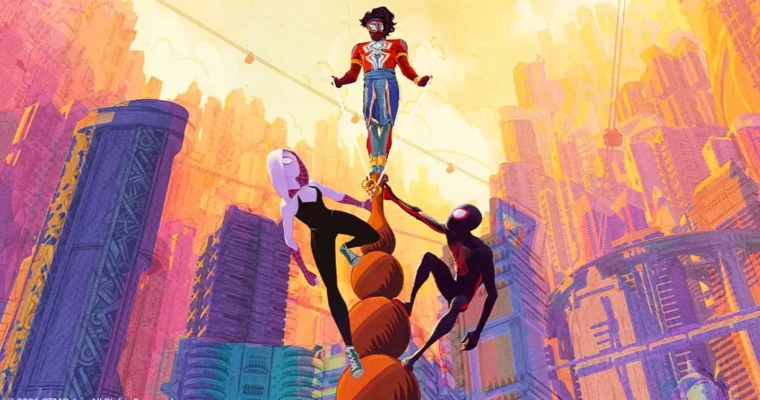
Preview: This masterclass pulls apart the visual language behind Across the Spider-Verse and turns it into decisions you can actually make on your own shots. No abstract theory — just mixed 2D/3D pipelines, color choices that carry emotion, and frame rates used as a deliberate artistic tool.
🎯 What you’ll learn
- Combine traditional 2D hand-drawn comic book techniques with fully rendered 3D CGI environments on the same shot.
- Build emotional color grading using hyper-stylized palettes — hot pinks, electric blues, purples — that reflect a character’s inner state instead of strict realism.
- Use background disassembly to control where the viewer looks during chaotic, destructive beats.
- Manipulate frame rate intentionally, dropping characters onto twos or threes to get a raw, stop-motion or anime feel.
- Match each visual dimension or universe to its own distinct artistic identity within a single production.
✅ Requirements
- Skills: Foundational drawing or illustration ability and a working understanding of animation timing; comfort with color theory and basic 3D concepts.
- Tools: Adobe Photoshop, Autodesk Maya or Blender, and a drawing tablet.
- Hardware: A machine that can render 3D scenes — dedicated GPU and 16GB RAM minimum.
📝 Description
Most animated features pick one look and defend it for ninety minutes. Across the Spider-Verse does the opposite: every dimension gets its own rules, its own line quality, its own color temperature. This masterclass breaks down how that actually gets built in a pipeline — not as a mood board, but as a set of repeatable decisions.
You start with the mixed-media problem: how to make hand-drawn comic marks sit on top of a fully lit 3D environment without looking pasted on. That leads straight into emotional color grading, where hot pinks and electric blues aren’t decoration. They’re a character’s internal state pushed to the surface of the frame.
Then things get strange in the best way. Disassembling reality means peeling backgrounds apart mid-impact, the way a misprinted comic panel would, so the audience feels the hit instead of just watching it. And frame-rate manipulation is the last tool in the box: dropping a character to twos or threes so a swing or a punch reads like stop-motion rather than smoothed-out CG.
The teaching puts “why” ahead of “how.” Every technique is tied to a specific emotional beat, so you’re not collecting tricks — you’re learning when breaking the rules lands and when it just looks broken.
🧑🎓 Who this course is for
- 2D animators and illustrators who want to work in stylized production without abandoning their line work.
- 3D artists, lighters, and compositors who keep getting asked for a “hand-drawn look” and want a systematic approach.
- Animation students and supervisors who need to understand how frame rate and color choices change the way a shot lands emotionally.
🧑🏫 About the Author
Miles Morales is the artist attached to this ArtStation masterclass, and the subject matter sits exactly where the Spider-Verse look lives: 2D line work, 3D environments, and a color script treated as a technical target rather than a finishing pass. The material comes from stylized animation production, where a single shot has to hold hand-drawn passes, CG renders, and deliberate frame-rate changes without falling apart. Additional credits and studio history are not listed in the source material for this class.
🏁 Final Result
- A stylized shot or short sequence that combines hand-drawn 2D elements with rendered 3D environments in a single, coherent frame.
- A working color script tied to specific emotional beats rather than generic palette choices.
- A documented frame-rate plan and background-disassembly pass you can show in a breakdown, plus the reel-ready material to prove
 Channel