

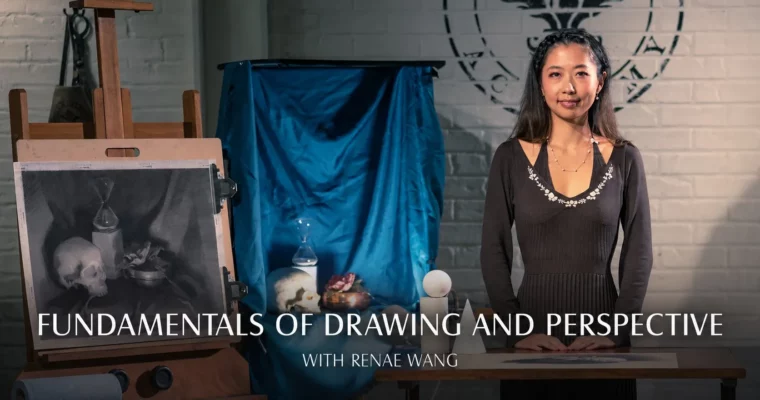
Fundamentals of Drawing and Perspective by Renae Wang

Duration:10 weeks
Actual Duration:24h 1m
Release date:2023
Publisher:New Masters Academy
Skill level:Beginner
Language:English
Exercise files:Yes
Software:Traditional Drawing
Course URL:https://www.nma.art/courses/fundamentals-of-drawing-and-perspective/
This 10-week course strips drawing back to what actually matters: seeing, measuring, and building forms that feel solid on a flat page. Renae Wang walks you through the entire process, starting with basic contour drawings and finishing with complex, multisession tonal still-lifes. No prior experience needed—just a willingness to look closely and put in the practice.
🎯 What you’ll learn
- Create accurate contour drawings of organic and geometric objects
- Apply one-, two-, and three-point perspective to draw interiors
- Use plumb lines and cross-contours to construct three-dimensional forms
- Understand light logic and value systems using toned paper
- Develop a three-value statement for still-life compositions
- Complete a long, multisession tonal drawing with hierarchy and detail
✅ Requirements
- Skills: No prior drawing experience required; this course is beginner friendly
- Tools: Traditional drawing materials (full list provided in lesson PDFs), including charcoal, white chalk, toned paper, and basic drawing supplies
- Hardware: A well-lit workspace; a drawing board or easel is recommended
📝 Description
This course is built around a simple idea: drawing is a skill you can learn, not a talent you’re born with. Renae Wang breaks down the process into manageable weekly steps, so you’re never overwhelmed. You’ll start with the basics—materials, contour lines, and simple shapes—and gradually build up to more complex challenges like perspective interiors and full tonal renderings.
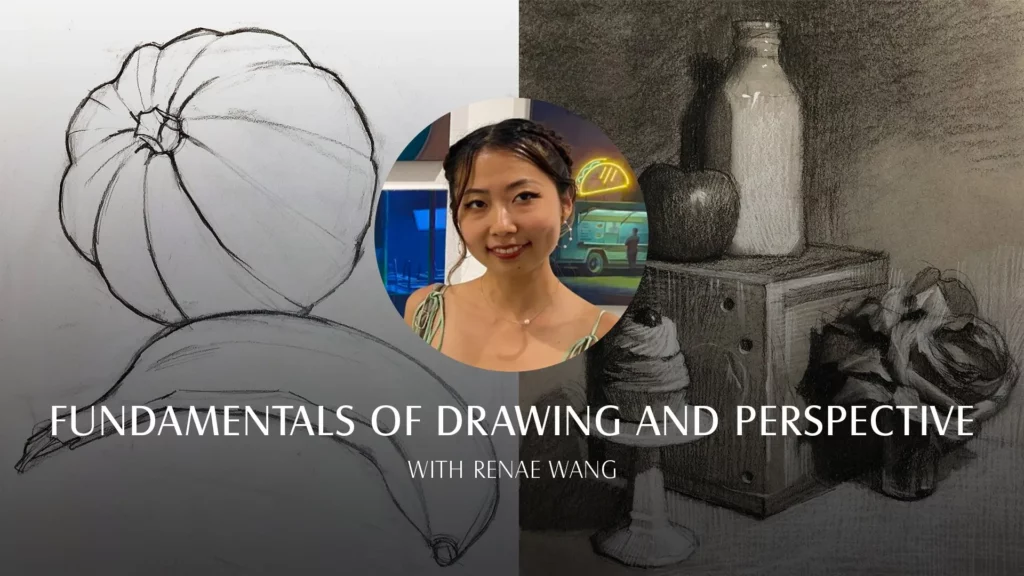
The teaching method here is highly practical. Each week introduces a new concept, demonstrates it clearly, and then gives you an assignment to lock it in. Renae emphasizes the importance of observational drawing throughout, teaching you to see the world as a series of forms, values, and spatial relationships rather than just outlines. You’ll learn to measure accurately, plan your compositions, and use linear perspective to create believable depth.
What sets this course apart is its focus on traditional media. Working with charcoal and toned paper forces you to think in terms of value and light logic from day one. You’ll learn how to construct a drawing from the ground up, using plumb lines and cross-contours to ensure accuracy before you ever pick up a shading tool. By the final weeks, you’ll be tackling complex still-lifes that require multiple sessions, learning how to maintain consistency and create visual hierarchy across a long project.
The course is structured to be flexible. While traditional materials are recommended, the fundamental principles translate directly to digital tools like Photoshop or Procreate. If you’re a digital artist looking to strengthen your foundational skills, you can easily adapt the exercises to your preferred software.
🧑🎓 Who this course is for
- Complete beginners who want a structured, no-nonsense introduction to drawing
- Self-taught artists looking to fill gaps in their understanding of perspective and value
- Digital artists who want to strengthen their traditional fundamentals
- Anyone preparing for more advanced figure drawing or environment design courses
🧑🏫 About the Author
Renae Wang is an instructor at New Masters Academy, where she teaches drawing fundamentals with a focus on observational techniques and traditional media. Her approach is methodical and accessible, breaking down complex concepts into clear, repeatable steps. She brings years of experience in art education, helping students from all backgrounds develop the technical skills needed to create convincing, dimensional artwork.
🏁 Final Result
By the end of this course, you’ll have a portfolio of drawings that demonstrate your progress from basic contours to complex, multisession tonal still-lifes. You’ll be able to construct accurate geometric and organic forms, apply perspective to interiors, and render light and shadow with confidence—skills that form the backbone of all visual art.
 Channel