

Robotic Planet (Chapter 12-14 Update) by Louis du Mont
Duration:15+ hours
Actual Duration:15h 19m
Release date:2026, July
Publisher:CGBoost
Skill level:Intermediate
Language:English
Exercise files:Yes
Software:Blender
Course URL:https://www.cgboost.com/courses/robotic-planet
This course is a full hard-surface production pipeline in Blender, built around creating robots from scratch. You’ll model, texture, rig, animate, and render two complete characters—Basic Bot and Fish Bot—using completely free tools. Plus, you get breakdowns of three additional robots (Owl, Snail, and Ostrich) to see how different techniques apply to varied designs.
The focus is on practical workflows for individual artists. No studio pipeline overhead, just efficient methods that actually save time. You’ll work with non-destructive modeling, procedural materials, and rigging systems that are flexible enough for real projects.
🎯 What you’ll learn
- Hard-surface modeling with booleans and non-destructive modifiers
- Subdivision surface modeling for smooth, organic robot forms
- Creating procedural edge, dirt, roughness, and scratch shader masks
- Building flexible rigs with constraints, drivers, and custom properties
- Animating characters with blocking, graph editor refinement, and add-ons
- Setting up stylized scenes with lighting, compositing, and viewport effects
✅ Requirements
- Skills: Good fundamental Blender knowledge is highly recommended. You should be comfortable with the interface, basic modeling, and navigation.
- Tools: A 3-button mouse is essential. A drawing tablet is optional but helpful for sketching ideas.
- Hardware: A dedicated GPU is recommended for smooth viewport performance, especially when working with Eevee and Cycles.
📝 Description
The course is split into three logical parts. First, you build Basic Bot using a boolean-heavy workflow. This covers blocking out primitives, adding details with boolean operations, using arrays for fine detailing, and understanding viewport properties. The materials chapter is where things get interesting—you’ll create procedural masks for edge wear, dirt, roughness, and scratches. These are resolution-independent, customizable, and keep your blend files small. You’ll organize everything into node groups for easy color variations across plastic, metal, decal, and lens materials.
Then comes Fish Bot, which takes a completely different approach. Instead of booleans, you’ll use subdivision surface modeling to achieve smooth contours. You’ll manipulate base meshes for cut-outs, use the Loop Tools add-on for circular projections, and model supporting geometry like water, bubbles, and jet exhaust. The rigging chapter here is more advanced, using drivers, constraints, geometry nodes, and custom properties for procedural animation. The Wiggle 2 add-on handles secondary motion.
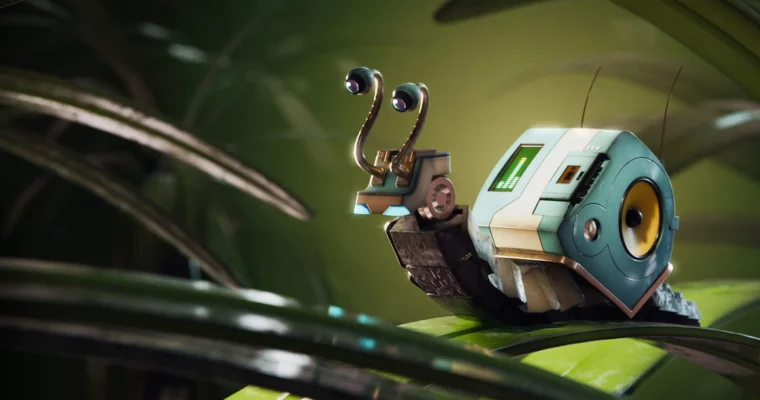
The final part breaks down three additional robots. Owl Bot covers CRT faces and telescopic legs with shader-based retro effects. Snail Bot links audio to speakers and builds a spectrum analyzer display. Ostrich Bot explores instancing, 3-chain IK legs with hydraulics, ribbon cables, and library overrides for creating a flock.
Throughout, the teaching style is direct and practical. Louis doesn’t waste time on theory you’ll never use. Every lesson builds toward a finished, shareable result. The course also includes all project files, English captions, and access to the CG Boost community.
🧑🎓 Who this course is for
- Blender users with solid fundamentals who want to specialize in hard-surface modeling
- Artists interested in the full character pipeline—modeling, materials, rigging, and animation
- Hobbyists and freelancers looking for efficient, non-destructive workflows
- Anyone who wants to create stylized robot animations for social media or portfolios
🧑🏫 About the Author
Louis du Mont has been a professional 3D artist since 2005. In 2012, he co-founded the animation studio Formation, where he works on commercial projects. Beyond client work, he’s passionate about personal projects that explore new techniques and tools. He regularly shares his discoveries with the CG community, and his teaching style reflects that—practical, experiment-driven, and focused on what actually works in production.
🏁 Final Result
By the end of the course, you’ll have two fully animated robot scenes ready for social media or your portfolio. Basic Bot comes with a complete stylized environment, lighting, and compositing. Fish Bot features a looping animation with procedural effects and real-time viewport compositing. You’ll also have the knowledge to tackle your own hard-surface projects from concept to final render.
 Channel