

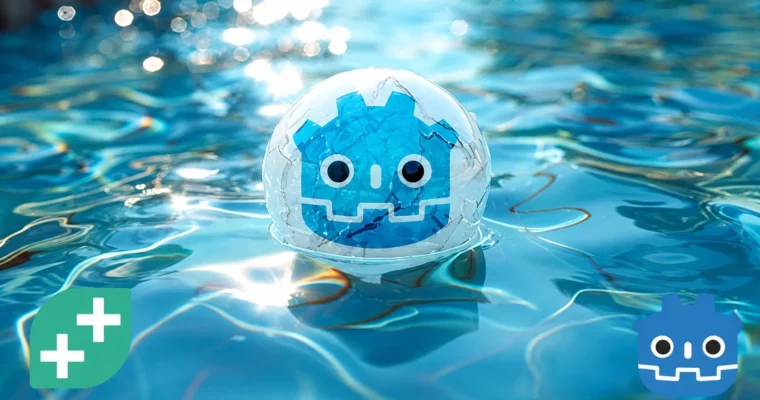
Godot 4 Shaders Craft Stunning Visuals by GameDev.tv Team (Kaan Alpar)
Duration:5 hours 10 minutes
Actual Duration:5h 10m
Release date:2025, May
Publisher:Udemy
Skill level:Intermediate
Language:English
Exercise files:Yes
Software:Godot 4
Course URL:https://www.udemy.com/course/godot-4-shaders
This course cuts the fluff and gets you writing shaders in Godot 4 from the very first lesson. You’ll start by understanding the core concepts of fragment and vertex shaders, then immediately apply them to build real effects like scrolling backgrounds, dissolve transitions, and a full 3D water shader. It’s a practical, hands-on path to making your games look significantly better.
🎯 What you’ll learn
- Write and understand Godot’s shading language from scratch.
- Build 2D effects like screen distortion, color mapping, and masking.
- Create 3D spatial shaders controlling albedo, metallic, and roughness.
- Develop a complete, animated 3D water shader.
- Manipulate vertices and use uniforms to control shaders from code.
✅ Requirements
- Skills: Basic familiarity with the Godot editor and its interface.
- Tools: A computer capable of running Godot 4.
- Hardware: A dedicated GPU is recommended for working with 3D spatial shaders.
📝 Description
This course is built for developers who know their way around Godot but feel stuck with flat, boring visuals. Instead of abstract theory, you’ll write code that produces immediate, visible results. The curriculum is split into three clear sections: the fundamentals of the shader language, practical 2D effects, and finally, 3D spatial shaders.
The 2D section is where things get fun. You’ll build a scrolling background, a dissolve effect, and a screen distortion shader. These aren’t just academic exercises—they’re effects you can drop directly into a platformer or RPG. The 3D section tackles the SpatialShader directly, teaching you how to control ALBEDO, metallic, and roughness properties. The capstone project is a water shader that combines vertex displacement with transparency and reflection.
Kaan Alpar, the instructor, keeps the pace brisk. He explains the math behind sine and cosine functions only as needed, focusing on how they drive animation. You’ll learn to pass data from GDScript to your shaders using uniforms, giving you full control over effects at runtime. By the end, you’ll have a solid mental model of the GPU pipeline and the confidence to build your own custom effects.
🧑🎓 Who this course is for
- Godot developers who want to move beyond basic materials and create custom visual effects.
- Game artists looking to understand the technical side of real-time rendering.
- Developers switching from other engines who need a focused, practical introduction to Godot’s shader system.
🧑🏫 About the Author
The course is delivered by the GameDev.tv Team, a well-known studio that has taught over a million students worldwide. The primary instructor, Kaan Alpar, is an independent game developer with over a decade of experience. He studied computer science at Japan Electronics College in Tokyo and has a knack for breaking down complex topics into digestible, practical lessons. His teaching style is direct and focused on getting you results, not just explaining theory.
🏁 Final Result
- A complete, animated 3D water shader ready for use in a game project.
- A library of reusable 2D shader effects (dissolve, distortion, scrolling background).
- A solid understanding of how to write and debug custom shaders in Godot 4.
 Channel