

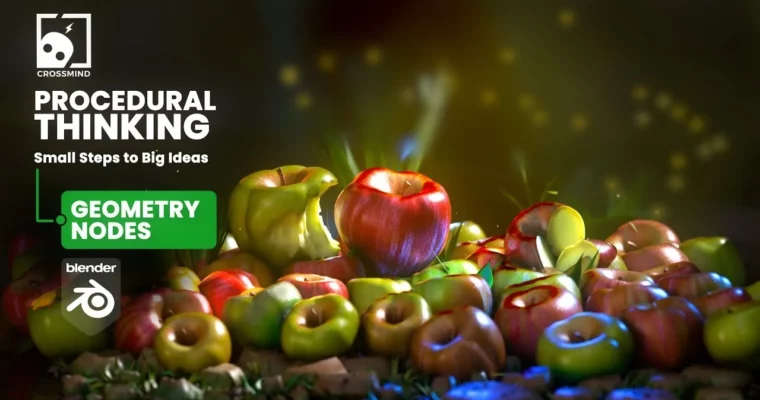
Procedural Thinking Blender 3D – Small Steps to Big Ideas by Ram@Crossmind

Duration:8 hours
Actual Duration:1h 57m
Release date:2026, May 12
Publisher:Gumroad
Skill level:Intermediate
Language:English
Exercise files:Yes
Software:Blender
Course URL:https://crossmindstudio.gumroad.com/l/proceduralthinking-blender
This course is about shifting your mindset. Instead of modeling one apple, you build a system that can make a hundred different apples. Ram from Crossmind Studio walks you through the logic of procedural modeling in Blender’s Geometry Nodes, using everyday objects as your training ground. You’ll learn to think in terms of reusable setups, not one-off models.
🎯 What you’ll learn
- Build adaptable node setups that generate multiple asset variations.
- Use Geometry Nodes attributes to control materials and shading procedurally.
- Create organic forms, lathe-based objects, and modular structures with nodes.
- Implement viewport gizmos for interactive controls.
- Optimize procedural assets for baking and low-poly export.
✅ Requirements
- Skills: Basic familiarity with Blender’s interface and navigation.
- Tools: A 3-button mouse.
- Hardware: A computer capable of running Blender 3.0 or higher.
📝 Description
This isn’t a “follow along and make one thing” course. Ram focuses on the why behind the nodes, not just the what. You’ll start by building simple objects like a book, then move to scattering systems and lathe-based forms. The core project is a fully procedural apple, but the real goal is teaching you to identify a good starting point for any asset.
The course is structured in three parts. First, you get the context: why proceduralism saves time and how to think about it. Then, you practice with simple setups, focusing purely on form-building. Finally, you apply everything to the apple, adding materials, group inputs, randomizers, and viewport gizmos. Ram also covers optimization for baking, so your procedural assets can be used in game engines or other DCC tools.
What sets this apart is the emphasis on reusability. You’ll learn to build setups that can be repurposed for different assets without starting from scratch. The bonus files include additional procedural objects to study, giving you more examples of how these techniques scale.
🧑🎓 Who this course is for
- 3D artists who want to speed up asset creation and stop doing repetitive manual modeling.
- Game developers and environment artists needing diverse, variation-rich assets.
- Intermediate Blender users ready to move beyond basic modifiers into Geometry Nodes.
- Anyone tired of rebuilding the same object multiple times due to design changes.
🧑🏫 About the Author
Ram is the founder of Crossmind Studio and an Animation Film Designer with two decades of experience. He has worked with clients like National Geographic, From Software, Samsung, and Sony. His work has earned back-to-back Promax Asia Awards for Best Ident Design. On YouTube, his Blender introduction series has crossed five million views, helping countless beginners get started. He brings that same clear, practical teaching style to this course.
🏁 Final Result
- A fully procedural apple asset with multiple states (fresh, rotten, sliced) and color variations.
- A reusable node setup that can be adapted for other organic and hard-surface objects.
- A low-poly baking module for exporting procedural assets to game engines.
 Channel