

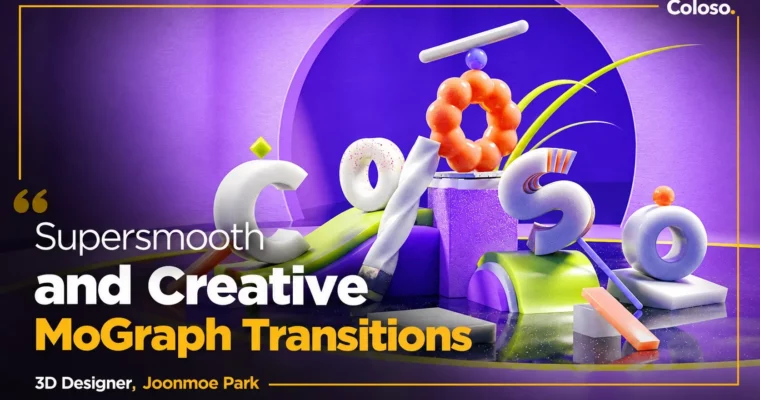
Supersmooth and Creative MoGraph Transitions by Joonmoe Park

Duration:15 Hours 18 Minutes
Actual Duration:45h 28m
Release date:2024
Publisher:Coloso
Skill level:Beginner
Language:Korean
Exercise files:Yes
Software:Cinema 4D, Octane Render, After Effects
Course URL:https://coloso.global/en/products/3dmotiongraphic-parkjoonmoe-us
If your style frames look good but your motion feels stiff, this class fixes that. Joonmoe Park walks you through his full process for building bright 3D scenes and linking them with smooth, punchy transitions.
🎯 What you’ll learn
- Build stable style frames with layout, light and shade, and color harmony
- Animate with PSR – Position, Rotation, Scale – and fix awkward motion with graphs
- Create object transitions using spline motion and speed similarity
- Direct camera transitions and dependent camera motion for scene development
- Build linear, rotation, and diffuse transitions for dynamic flow
- Light and texture with Octane Renderer and GSG textures for dense looks
- Finish work with After Effects color correction and post-processing
✅ Requirements
- Skills: Basic understanding of Cinema 4D interface and keyframe animation
- Tools: Cinema 4D, Octane Renderer, Grayscale Gorilla plugin, After Effects
- Hardware: Dedicated NVIDIA GPU for Octane rendering, minimum 16GB RAM
📝 Description
This class is not about random tricks. It is about why some motion feels cheap and how to fix it. Joonmoe starts with the stuff people skip — light and shade, color harmony, and layout — then shows how those choices make your transitions easier later.
You will work through the same loop on every example: model a simple scene in Cinema 4D, light and texture it with Octane Renderer and GSG, animate it, then polish in After Effects. Repetition is the point. By the third or fourth scene, you start to predict how a shot should connect to the next one.
The middle of the course covers PSR animation properly. Position, Rotation, Scale sounds basic, but he shows how to use graphs, timing, and sweep to add snap and chewiness without making it wobbly. From there you move into the core transition types: object morphs along splines, camera-driven scene changes, plus linear, rotation, and diffuse transitions.
What makes it useful is the focus on speed similarity and scale difference. You learn to match velocity between outgoing and incoming scenes so cuts disappear. If you freelance broadcast titles, brand films, or social motion, that one idea alone will clean up your work fast.
🧑🎓 Who this course is for
- Beginners in 3D motion graphics who can make stills but struggle with natural movement
- Cinema 4D users who want a repeatable workflow for style frames to final animation
🧑🏫 About the Author
Joonmoe Park is a 3D motion graphics designer currently at Naver Z, formerly at Super Barrymore. He started in broadcast, working on broadcast titles and channel branding for tvN, Discovery Korea, Channel A, NQQ, OLIFE, and SK broadband.
He has since led product graphics and brand films for ZEPETO and NAVER Z, alongside personal projects like Wake Up the Shape. Known on Instagram for clean motion and cheerful color, he teaches the exact planning-to-finish process he uses to deliver high-quality work fast.
🏁 Final Result
- A set of finished 3D motion graphics clips built around 5 transition types — object, camera, linear, rotation, and diffuse — with Octane-lit style frames, animated and finished in After Effects, ready for your reel.
📢 Guys, this is a Group Buy campaign, check the GBC forum thread to get access
You can find the course preview in the download section below.
 Channel