

Specialization in Graphic Design and Visual Communication by Silvia Ferpal

Duration:18h 12m
Actual Duration:18h 59m
Release date:2025
Publisher:Domestika
Skill level:Beginner
Language:English
Exercise files:Yes
Software:Adobe Photoshop, Adobe Illustrator, Adobe InDesign
Course URL:https://www.domestika.org/en/courses/5642-specialization-in-graphic-design-and-visual-communication
This specialization gives you the foundations that actually stick. You will work through color theory, composition, and visual perception with six working designers, and turn all that theory into a coherent Instagram system and visual universe of your own.
🎯 What you’ll learn
- Build your own visual universe using shape, typography, and color
- Apply color functions, harmony, contrast, and functional classifications
- Structure layouts with balance, space, asymmetry, and movement
- Use the laws of visual perception: unity, weight, balance, and rhythm
- Create graphic resources and identity systems from simple geometry
- Design posters, illustrations, and layouts that communicate clearly
- Think like an identity designer and build lasting, logical brands
✅ Requirements
- Skills: No prior design experience needed, just curiosity and willingness to experiment
- Tools: Computer with basic graphic design software, notebook and pencil for sketching ideas
- Hardware: Computer with internet connection for streaming lessons
📝 Description
This is not a software-click course. It is about how you see and how you decide. You start with the basics with Silvia Ferpal — shape, type, image — and you build a small visual world that is yours. Then you break it and rebuild it with color, structure, and perception.
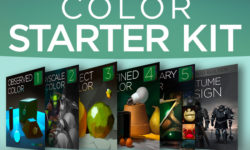
The color theory section with Leire Fernández and Eduardo Herrera is super practical. You learn what color does, not just what it looks like. Harmony, contrast, how to classify color by function, and how to pick palettes that do a job instead of just looking nice.
Then Javier Alcaraz gets into composition step by step. Color, shape, space, balance, asymmetry. How to set up a grid without killing the idea. How to make an editorial layout or a poster that reads fast and holds attention. If you want to go further in Adobe InDesign, this is a solid base for it.
My favorite part is the perception module with Pepe Gimeno. He works with waste materials and experimental graphics to show visual perception in action — unity, weight, balance, movement. It teaches you to work with limits. Poster, illustration, layout, type — same laws apply.
You close with geometry and branding. Esteban Ibarra shows how much you can do with just circles, squares, and triangles to create flexible visual identities. Enric Jardí wraps it up with clear thinking for identities that last: less decoration, more logic.
🧑🎓 Who this course is for
- Aspiring graphic designers and art students who want solid fundamentals
- Self-taught creatives who make stuff but want structure behind it
- Professionals from nearby fields who need stronger visual and identity skills
🧑🏫 About the Author
Silvia Ferpal is a graphic designer and winner of the 2019 Spanish National Design Award. She is known for her timeless, concept-driven approach to graphic design and for helping students turn imagination into working visual systems.
She is joined by five specialists: Leire Fernández and Eduardo Herrera, PhDs in Fine Arts focused on color and communication, Javier Alcaraz, expert in editorial, branding and typography, Pepe Gimeno, multidisciplinary designer and artist, Esteban Ibarra, specialist in geometric identity systems, and Enric Jardí, expert in editorial design and corporate image.
🏁 Final Result
- A series of Instagram templates expressing your personal visual universe, built from your own system of shapes, typography, color, and composition — ready to post and add to your portfolio.
 Channel