

Ad Clicks : Ad Views : Ad Clicks : Ad Views : Ad Clicks : Ad Views : Ad Clicks : Ad Views :
Oh Snap!

It looks like you're using an adblocker. Adblockers make us sad. We use ads to keep our content happy and free. If you like what we are doing please consider supporting us by whitelisting our website. You can report badly-behaved ads by clicking/tapping the nearby 'Advertisement' X text.

The Art Of Music Editing by Chris Macdonald
The Art Of Music Editing by Chris Macdonald

Author:Chris Macdonald

Duration:Over 14 Hours of Training

Actual Duration:15h 0m

Release date:2025

Publisher:FIlm Editing Pro

Skill level:Advanced

Language:English

Exercise files:Yes

Software:Premiere Pro, DaVinci Resolve, Avid Media Composer, Final Cut Pro

Course URL:https://www.theartofmusicediting.com/

Learn how to analyze, cut, and mix music so it locks to picture and sells every story beat.

Stop just laying a track under your cut and hoping it works. This course shows you how to pick the right cue, take it apart, and rebuild it so it actually fits your story.

🎯 What you’ll learn

  • Understand the 4 main functions of music in film and when to use each one
  • Find, analyze, and prep music cues before you make a single cut
  • Place clean music edits with crossfades, loops, and repeating elements
  • Accent dramatic moments, build variety, and use tones and drones
  • Start and stop cues naturally with ringouts and reverses
  • Mix music to picture with levels, keyframes, auto ducking, and EQ notching
  • Cut :05 to 2:00 versions of the same spot and score full scenes with stems

✅ Requirements

  • Skills: Basic understanding of video editing and timeline trimming
  • Tools: Any NLE – Premiere Pro, DaVinci Resolve, Avid, or Final Cut Pro, plus headphones or studio monitors
  • Hardware: Computer capable of HD video playback, 16GB RAM recommended, external drive for practice footage

📝 Description

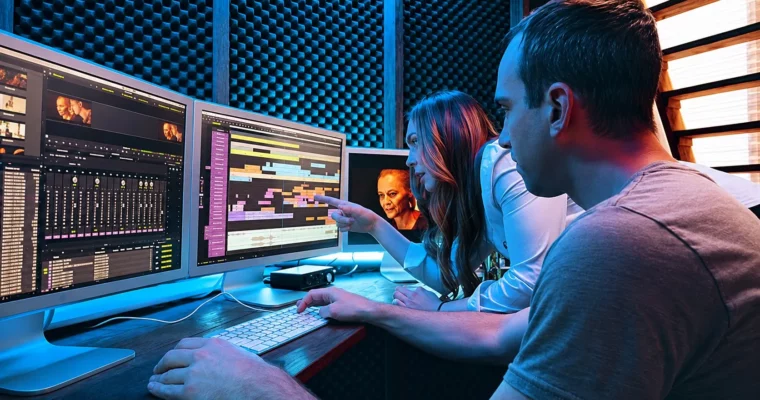
Most editors treat music like wallpaper. Drop it in, fade it out, done. Problem is, viewers feel when it’s off, even if they can’t explain why. This course fixes that. You learn how to listen like an editor — break down structure, tempo, and energy, then rebuild the cue around your cut.

You start with the basics that actually matter: what music is supposed to do in a scene, how to pick cues that fit, and how to prep them. Then you get into the hands-on stuff — crossfades, spotting, and clean edit points. No guesswork. You’ll know exactly where music should start, where it should get out of the way, and how to join two pieces without that awkward bump.

Then it gets fun. You’ll work with loops, accents, variety edits, and tones and drones to stretch a 30-second library track into a two-minute scene without it sounding looped to death. You’ll also learn ringouts and reverses to get in and out of cues like you meant it.

Mixing gets its own full section, because a great edit dies with a bad mix. You’ll set levels that leave room for dialogue, ride volume with keyframes, record live automation, use auto ducking when you’re in a hurry, and carve space with EQ notching. Practical stuff you can use tomorrow.

The best part is you don’t just watch — you cut. Four workshops walk you through real jobs: cutting a promo down from 2:00 to :05, scoring a full short film scene by scene, and working PRO-level stems for a dramatic finale. Plus 50+ assignments and breakdowns of pro edits, including what to do when you’re stuck with a bad edit and have to save it.

🧑‍🎓 Who this course is for

  • Video editors who want music to feel intentional, not temp and hopeful
  • Filmmakers cutting shorts, docs, and features on tight deadlines with library music
  • Freelancers cutting ads, promos, and online content who need fast, clean cutdowns
  • Assistants and junior editors who want a real, hireable music editing skill

🧑‍🏫 About the Author

Chris Macdonald is an editor and educator and founder of Film Editing Pro. He’s spent years breaking down what working editors actually do day-to-day and turning it into straight, no-fluff training. His courses focus on story, pacing, and sound — the stuff that gets you hired again. With The Art of Music Editing, he teaches the exact spotting, cutting, and mixing workflow he uses to make library music sound custom-scored.

🏁 Final Result

  • A fully scored short film sequence plus commercial cutdowns from 2:00 to :05, cut, accented, and mixed to broadcast-ready levels — ready to show how you handle music from spotting to final mix.
Curriculum

📋 Course content

  1. Module 1:  Foundations – What Music Actually Does
    • Welcome to The Art of Music Editing
    • How This Course is Organized
    • The 4 Main Functions of Music in Film
    • Musical Styles, Genres and Meaning
    • Creating Emotional Tones & States
    • How to Find the Right Music
  2. Module 2:  Core Editing Techniques
    • How to Analyze & Prep a Music Cue
    • How to Correctly Use Crossfades
    • How to Place & Join Music Edits
    • Spotting for Editors: Where Does the Music Go?
    • Accenting Dramatic Moments with Music
    • Cutting Loops & Repeating Elements
    • Adding Variety to Your Music
    • The Importance of Tones & Drones
    • How to Use Tones & Drones With Music
    • How to Start & Stop Music with Ringouts and Reverses
  3. Module 3:  Mixing Music to Picture
    • Music Mixing & Level Guidelines
    • Mixing with Keyframes & Rubber Banding
    • Mixing with Edits & Crossfades
    • Mixing with Live Automation Recording
    • Mixing with Auto Ducking
    • Mixing with EQ & Notching
  4. Module 4:  Workshop – Promo Cutdowns from 2:00 to :05
    • Introduction & Project Overview
    • Cutting the 2:00 Version – Part 1
    • Cutting the 2:00 Version – Part 2
    • Cutting the 1:00 Version – Part 1
    • Cutting the 1:00 Version – Part 2
    • Cutting the :30 Version – Part 1
    • Cutting the :30 Version – Part 2
    • Cutting the :15 Version – Part 1
    • Cutting the :15 Version – Part 2
    • Cutting the :05 Version
  5. Module 5:  Workshop – Scoring a Short Film Start to Finish
    • Project Overview
    • Setting Up the Project
    • Creating Your Music Roadmap with Spotting
    • Gathering & Organizing Your Music
    • Laying Out a Rough Music Pass – Part 1
    • Laying Out a Rough Music Pass – Part 2
    • Going Beyond the Rough Cut
    • Scoring the Intro Sequence
    • Scoring the City Sequence
    • Scoring the Bar Scene – Part 1
    • Scoring the Bar Scene – Part 2
    • Scoring the Apartment Scene – Part 1
    • Scoring the Apartment Scene – Part 2
    • Scoring the Finale
    • Creating the Final Mix
    • Reviewing the Final Cut
    • Reviewing Key Lessons Learned
    • Next Steps
  6. Module 6:  PRO Edit Breakdowns
    • PRO Edit Demo – Spotting
    • PRO Edit Demo – Cutting Accents
    • PRO Edit Demo – Cutting Loops
    • PRO Edit Demo – Adding Variety
    • PRO Edit Demo – Mixing
    • PRO Edit Demo – Drones
    • PRO Edit Demo – Editor vs Composer
  7. Module 7:  PRO Workshop – Working with Stems
    • PRO Project Overview & Introduction to Stems
    • PRO Setting Up & Organizing the Project
    • PRO Scoring Duncan’s Death Scene – Part 1
    • PRO Scoring Duncan’s Death Scene – Part 2
    • PRO Scoring Duncan’s Death Scene – Part 3
    • PRO Scoring the Love Theme – Part 1
    • PRO Scoring the Love Theme – Part 2
    • PRO Scoring James’ Tense Moment – Part 1
    • PRO Scoring James’ Tense Moment – Part 2
    • PRO Scoring James’ Tense Moment – Part 3
    • PRO Scoring the Finale Sequence – Part 1
    • PRO Scoring the Finale Sequence – Part 2
    • PRO Scoring the Finale Sequence – Part 3
    • PRO Reviewing the Final Cut
    • Bonus Lesson: How to Fix Bad Music Edits
Watch online or Download for Free
The Art Of Music Editing by Chris Macdonald
NAME
SIZEDURATION

Download all Videos (74)
1.3 GB15h 0m


Download all

Join us on
  Channel    and      Group

Leave a Comment

Your email address will not be published. Required fields are marked *