


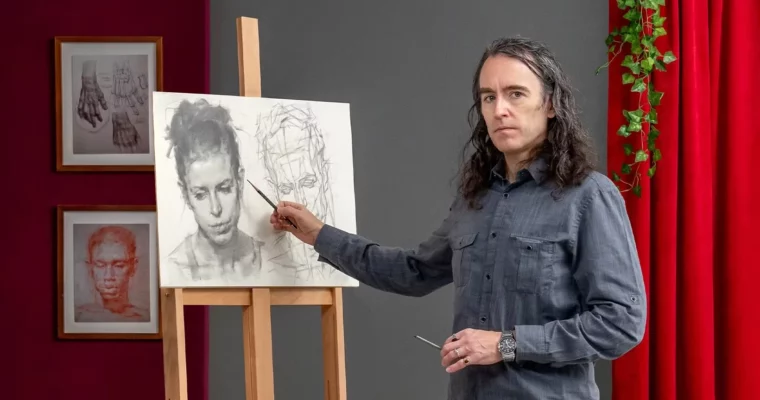
Graphite Drawing Techniques for Planar Portraiture by Dan Thompson

Actual Duration:5h 53m
Release date:2022, June
Publisher:Domestika
Skill level:Intermediate
Language:English
Exercise files:Yes
Software:Graphite
Course URL:https://www.domestika.org/en/courses/2428-graphite-drawing-techniques-for-planar-portraiture
Learn to draw the human head as a system of interlocking planes. This course teaches you to see past the surface and build portraits using structural forms, tonal information, and schematic abstraction. You’ll work from observation, but the goal isn’t photorealism—it’s understanding the geometry underneath.
🎯 What you’ll learn
- Break down the head into simple block and trapezoid forms
- Apply optical and tonal information to your drawings
- Create schematic drawings that reinterpret naturalistic observation
- Experiment with planar modules to produce abstract portraits
✅ Requirements
- Skills: Basic drawing experience is helpful but not required.
- Tools: Graphite pencils of varying hardness, a razor or penknife, sandpaper, a kneaded eraser, and medium-texture paper.
- Hardware: A well-lit workspace.
📝 Description
This isn’t your typical portrait class. Dan Thompson throws out the rulebook on shading and blending and instead asks you to think like a sculptor. You’ll start by drawing simple blocks and trapezoids, then gradually layer in optical information—what you actually see—before switching to tonal information to map light and shadow. The real magic happens when you move into schematic drawing, where you reinterpret the naturalistic head as a system of flat planes.
The course is built around two projects: one abstract portrait from direct observation, and a second structural, linear study of the same subject. Dan walks you through every step, explaining his thought process as he draws. You’ll learn to see the head not as a smooth surface, but as a collection of facets—like a low-poly model in 3D software, but with graphite.
🧑🎓 Who this course is for
- Artists who want to improve their portrait drawing skills
- Anyone curious about experimental, non-photorealistic portraiture
- Students of figure drawing looking for a structured, analytical approach
🧑🏫 About the Author
Dan Thompson is an artist and educator with over 20 years of experience. He founded two art schools in New York and currently serves as dean of fine arts at Studio Incamminati, as well as faculty chair at the New York Academy of Art. His work has been recognized with grants from the Elizabeth Greenshields Foundation and the Ethel Lorraine Bernstein Memorial Award. In 2001, he won Best of Show at the American Society of Portrait Artist’s International Portrait Competition at the Metropolitan Museum of Art. His drawings and paintings are held in collections across the U.S., Canada, Europe, and the Middle East.
🏁 Final Result
- Two finished drawings: one abstract planar portrait from life, and one structural linear study of the same subject.
 Channel




THANK YOU SO MUCH!